Introduction: Welcome to the Atelier, Let’s Awaken Your Doll
I remember it like it was yesterday – the thrill of unboxing my very first ball-jointed doll. That pristine, beautiful creature, lying there in its box, a blank canvas brimming with potential. My heart pounded with excitement, imagining all the stories we would tell together. Yet, beneath that excitement was a tremor of fear. How do I even begin to pose this delicate beauty without breaking it? Every joint seemed so fragile, every movement a potential disaster. Don’t worry, we’ve all been there. That moment of awe mixed with apprehension is a rite of passage for every new BJD owner.
You’ve brought home more than just a doll; you’ve welcomed a companion, a muse, a silent storyteller waiting for its voice. My blog, “jointed muse’s Doll Atelier,” has been a beacon for BJD enthusiasts for over 15 years, built on a foundation of deep care and respect for these unique art pieces. My mission, and the purpose of this guide, is to be your personal mentor. I’ll walk you through every step, from that initial “I’m afraid to touch it” stage to confidently bringing your doll’s personality to life through expressive, safe posing. Consider this your first “posing bible,” designed to empower you to awaken your doll’s soul, risk-free. Let’s embark on this beautiful journey together.
The Unbreakable Vow: Safety First, Pose Second
Before we even think about striking a pose, we must establish our golden rule: your doll’s health and longevity always come first. Posing is an art, but it’s an art built on understanding and respect for the delicate engineering of your companion.
Before You Pose: The Crucial 2-Minute Health Check
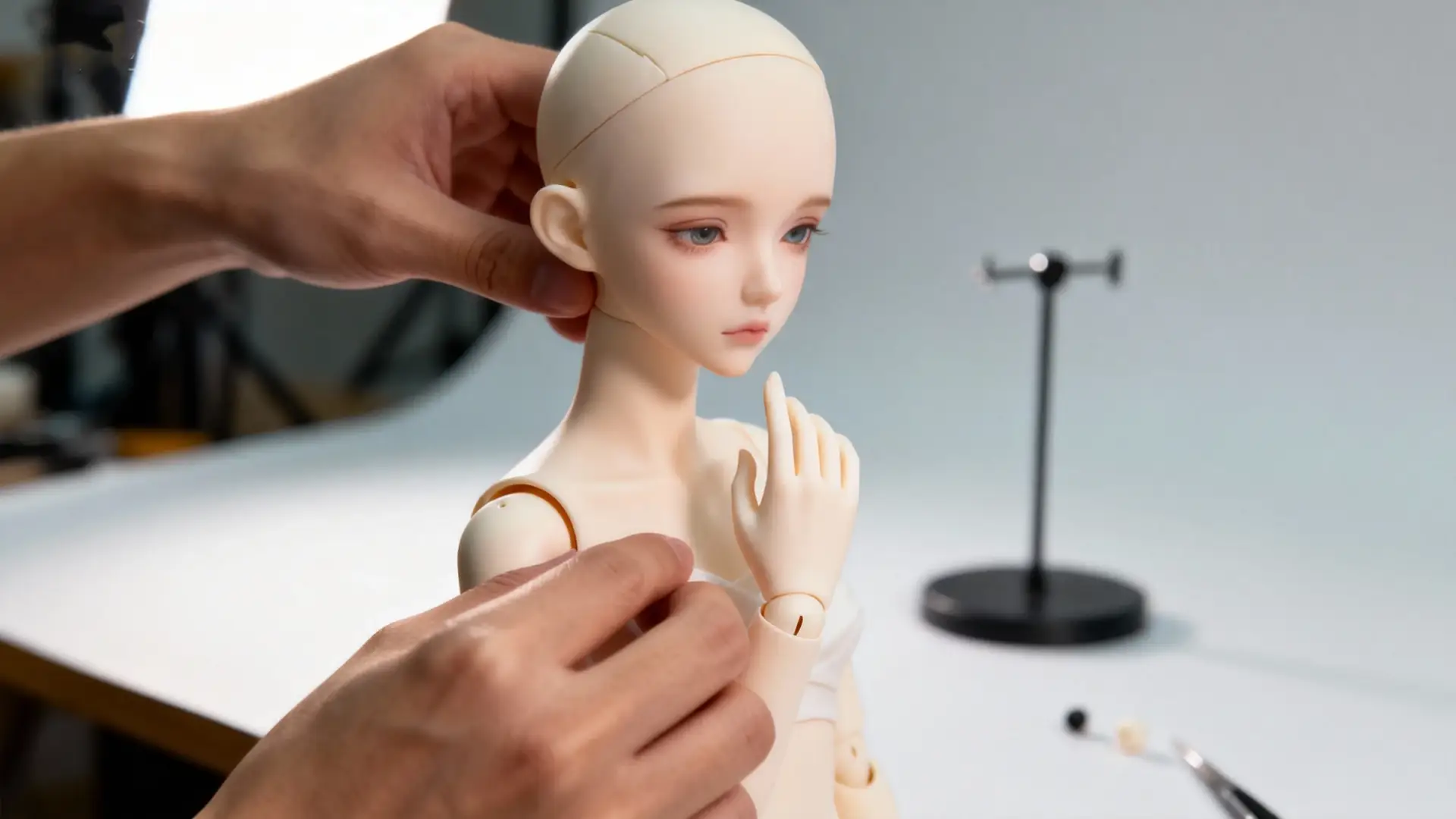
Every time you prepare for a photoshoot or simply want to change your doll’s display pose, take two minutes for a quick health check. This simple routine can prevent a world of heartache.
Checking Stringing Tension: This is the absolute foundation of stable posing. Your BJD’s limbs are held together by internal elastic cords, collectively known as stringing, running through its body. The elastic tension of this stringing dictates how well your doll can hold a pose.
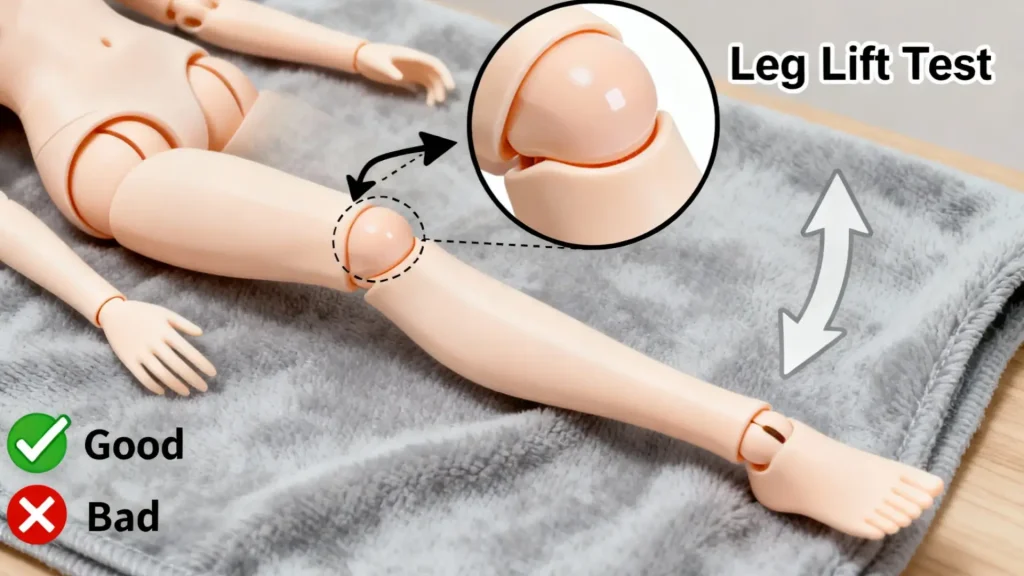
- The “Leg Lift” Test: Gently lift one of your doll’s legs.
- Too Loose: If the leg flops back down immediately or feels excessively wobbly, your stringing tension is too loose. This will make posing incredibly frustrating and unstable.
- Too Tight: If the leg springs back up with too much force, or if the joints feel overly stiff and difficult to move, the stringing tension is too tight. This puts undue stress on the resin and can lead to stress lines or even cracking.
- Just Right: The leg should hold its position when lifted, offering a slight, controlled resistance when you move it. It should feel firm but not rigid.
Why it matters: Proper stringing tension provides the necessary friction and stability within the ball joints to hold a pose. Without it, your doll will be a floppy mess; with too much, you risk damaging the delicate resin.
Joint Inspection: Before any posing session, quickly scan your doll’s joints.
- Foreign Objects: Check for any dust, hair, or debris lodged in the joint sockets. Even a tiny particle can cause friction and potential damage.
- Early Stress Signs: Look for any faint white lines, especially around the edges of the joint sockets or where limbs meet the torso. These are early stress lines, indicating that the resin is under strain. If you see them, ease up on extreme poses and consider adjusting stringing tension.
Understanding Your Doll’s Soul – Anatomy 101
To pose safely, you need to understand the intricate dance between your doll’s internal structure and its external form.
Your BJD is a marvel of engineering, designed to mimic human articulation. Its limbs are connected by ball joints – spheres that fit into sockets, allowing for a wide range of motion. These joints are held together by the internal stringing, which is anchored by S-hooks (small metal hooks shaped like an ‘S’) at the extremities (hands, feet, head). The stringing runs through channels drilled within the resin body parts.
Expert Insight: The magic happens when the stringing tension pulls the ball joints firmly into their sockets, creating enough friction for the limbs to hold a position. It’s a delicate balance.
It’s also crucial to remember that not all BJDs are created equal. Different sizes – 1/3 (SD), 1/4 (MSD), 1/6 (YoSD) – and brands like Volks, Luts, Dollfie Dream, and countless independent artists, all have unique joint designs and resin formulations. Always refer to your doll’s official manual or the manufacturer’s website for specific care instructions. Some brands have double-jointed knees and elbows for greater articulation, while others might have simpler, single joints. Understanding these nuances will inform your posing choices.
Considering Different Body Types:
- 1/3 Scale (SD dolls): These larger dolls, often weighing several pounds, require more precise adjustments for standing poses. Their increased weight puts greater stress on the ankle and knee joints, and the stringing needs to be perfectly balanced to prevent wobbling. Achieving a stable, unassisted stand with an SD doll is a true test of patience and skill.
- 1/6 Scale (YoSD dolls): Smaller and lighter, these dolls are often more forgiving and can achieve a wider range of dynamic poses with less effort. Their lighter weight means less strain on the stringing and joints, making them excellent for experimenting with expressive, action-oriented stances.
The Silent Enemies: Stress Lines, Yellowing, and Color Transfer
These are the hidden dangers that can slowly diminish your doll’s beauty and value. Awareness is your best defense.
- Stress Lines: As mentioned, these are fine white lines that appear on the resin, often near joints or thin areas. They are caused by excessive pressure or strain on the resin. Trust me on this, I’ve seen beautiful dolls marred by stress lines from being forced into unnatural positions or left in extreme poses for too long. They are a permanent scar.
- Yellowing (Yellowing): Resin, especially lighter shades, naturally yellows over time due to UV exposure and oxidation. While unavoidable to some extent, direct sunlight significantly accelerates this process.
- Color Transfer: This is when dyes from clothing, wigs, or accessories bleed onto the resin, leaving permanent stains. Dark fabrics, especially new ones, are notorious culprits.
Prevention is Key:
- Stress Lines: Never force a joint. If it resists, stop. Avoid leaving your doll in extreme, gravity-defying poses for extended periods.
- Yellowing: Store your doll away from direct sunlight. If displaying, consider UV-protective glass for display cases.
- Color Transfer: Always wash new dark clothing before putting it on your doll. Better yet, use a body stocking (a thin, light-colored garment) underneath any dark or brightly colored outfits. This creates a protective barrier.
jointed muse’s Safety Alert
NEVER force a joint past its natural range of motion. If you feel significant resistance, stop immediately. Forcing a joint can cause irreversible stress lines, cracking, or even breakage of the resin. Listen to your doll; it will tell you its limits.
Your Posing Toolkit: More Than Just a Stand
While your hands are your primary tools, a few essential accessories will make your posing journey safer and more enjoyable.
The Posing Stand: Your Doll’s Best Friend
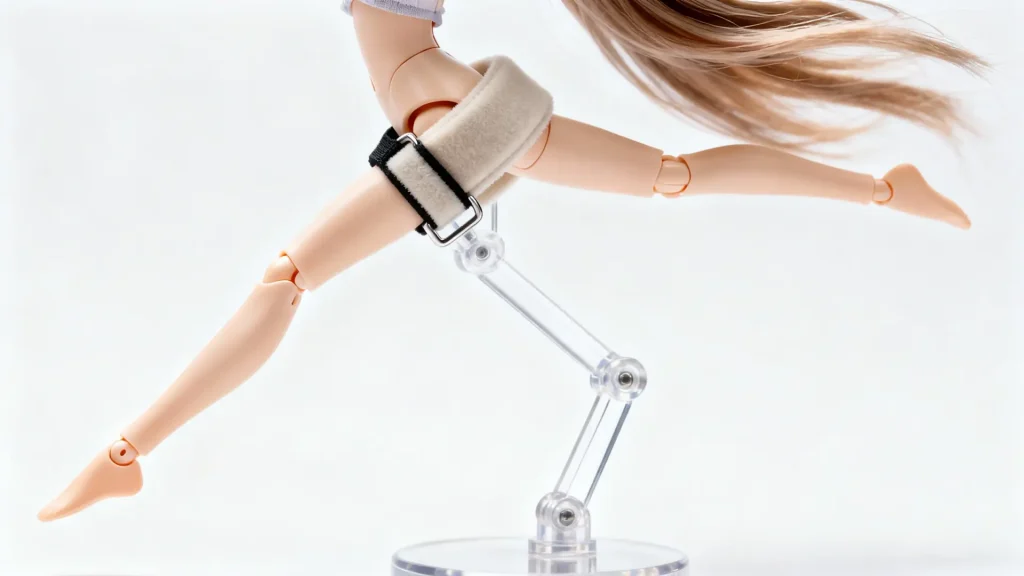
A good posing stand isn’t just an accessory; it’s a necessity, especially for beginners. It provides crucial support, preventing falls and allowing you to experiment with more dynamic poses without fear.
BJD Posing Stand Tutorial:
- Choosing the Right Stand:
- Waist-Clip Stands: These are the most common. They feature a padded clip that secures around your doll’s waist. Ensure the clip is well-padded to prevent color transfer or indentations on the resin.
- Saddle Stands: These have a ‘T’ shaped support that fits between the doll’s legs, supporting it from the crotch area. They are excellent for dolls wearing delicate clothing around the waist or for very dynamic poses where a waist clip might interfere.
- Magnetic Stands: Less common but very stable, these use magnets embedded in the doll’s feet and a metal base. They offer a very clean look but require modification to the doll.
- Correct Support:
- Waist-Clip: Position the clip firmly but gently around the doll’s waist, ensuring it’s not too tight. The stand’s pole should align with the doll’s spine, providing central support.
- Saddle Stand: Carefully place the ‘T’ bar between the doll’s legs, ensuring it supports the doll’s weight without putting undue pressure on the inner thighs or crotch area.
- Avoiding Pressure: Always ensure the stand isn’t pressing too hard on any part of the doll, especially the waist or clothing. Long-term pressure can cause indentations or color transfer.
jointed muse’s Safety Alert
Any pose involving a single leg, jumping, or significant dynamic movement absolutely requires a posing stand. Attempting these without proper support is a recipe for disaster and potential damage to your doll. Always prioritize stability.
My Secret Weapons: Eye Putty and Sueding
These are two little tricks that can make a big difference.
- Eye Putty: This sticky, reusable putty (often used to secure doll eyes) is incredibly versatile. I use it to temporarily fix a doll’s hands in a specific gesture, hold tiny props, or even stabilize a wig that keeps slipping. It’s gentle on the resin and leaves no residue.
- Sueding: This is an advanced technique where thin strips of suede or similar material are glued inside the joint sockets. It increases friction, making the joints stiffer and better able to hold poses, especially for older dolls with looser joints. It’s a fantastic way to rejuvenate a floppy doll, but it’s a permanent modification best left to experienced collectors or professionals.
Foundational Poses: Building from the Ground Up
Let’s start with the basics. Mastering these will give you the confidence to explore more complex expressions.
The Art of Standing: How to Make BJD Stand On Its Own
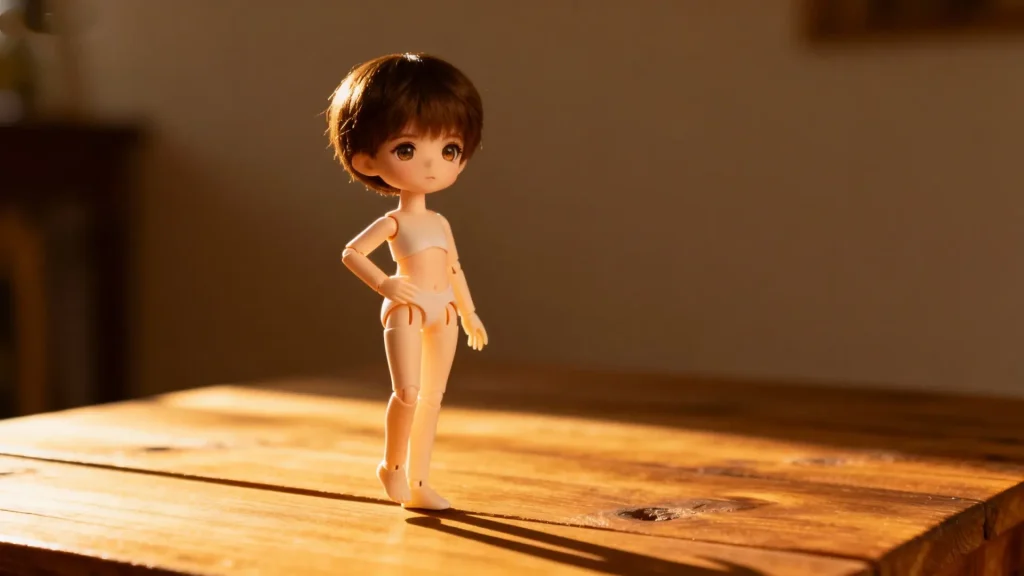
Getting your BJD to stand unassisted is a milestone. It requires patience and a keen eye for balance.
- Start with the Feet: Ensure the feet are flat on the surface. Many BJD feet have a slight curve; you might need to gently adjust the ankle joint to compensate.
- Ankle Adjustment: This is critical. The ankle joint needs to be positioned so the doll’s weight is evenly distributed through the foot. A slight forward or backward tilt can throw off the entire balance.
- Knee Bend: A very subtle bend in the knees often helps. It allows for a more natural, relaxed stance and provides a small “spring” for balance. Avoid locking the knees straight back, as this can look unnatural and put stress on the joint.
- Hip Alignment: The hips should be level. If one hip is higher than the other, the doll will lean. Gently adjust the hip joints until the pelvis feels balanced.
- Torso and Spine: Ensure the torso is upright and aligned with the hips. A slight curve in the spine can add naturalism, but avoid extreme leaning.
- Head and Arms: Once the lower body is stable, gently position the head and arms. These can subtly shift the center of gravity, so make small adjustments.
Personal Experience: I remember my first SD doll, a beautiful girl named Elara. I spent an entire afternoon trying to get her to stand on her own. I was frustrated, thinking her stringing was off. The secret, I discovered, wasn’t in her stringing, but in a tiny, almost imperceptible 2-millimeter micro-adjustment of her ankle joints. That small tweak made all the difference, and she stood proudly. It taught me that patience and precision are your greatest allies.
Graceful Sitting: Protecting the Spine and Hips
Sitting poses are often easier than standing, but still require care to protect the delicate spine and hip joints.
- Utilize Support: Always use a chair, cushion, or the ground to support your doll’s weight.
- Natural Curve: Allow for a natural curve in the spine. Avoid forcing the back perfectly straight or into an extreme hunch.
- Hip Angle: Ensure the hips are at a comfortable angle, typically around 90 degrees when sitting on a flat surface. Avoid pushing the legs too far back, which can strain the hip joints.
- Leg Position: Let the legs fall naturally. They can be together, crossed, or slightly apart.
The Language of Hands: Simple BJD Hand Poses
Hands are incredibly expressive. Even subtle changes can convey a wealth of emotion.
- Natural Rest: The simplest pose is a relaxed, natural hang. Let the fingers gently curl.
- Gentle Touch: Position one hand to lightly touch the doll’s own face, hair, or another part of its body. This conveys introspection or tenderness.
- Intertwined Fingers: For a thoughtful or shy look, gently interlace the fingers.
- Holding Props: Use eye putty to secure small props like a book, a flower, or a teacup.
- Changing Hands: Most BJDs have removable hands. To change them, gently pull the hand off the wrist joint. Be careful not to pull too hard on the stringing. When attaching a new hand, align the S-hook and gently push it into the wrist socket.
Level Up! An Introduction to Dynamic & Emotional Posing
Once you’re comfortable with foundational poses, you can begin to explore more dynamic and emotionally resonant expressions.
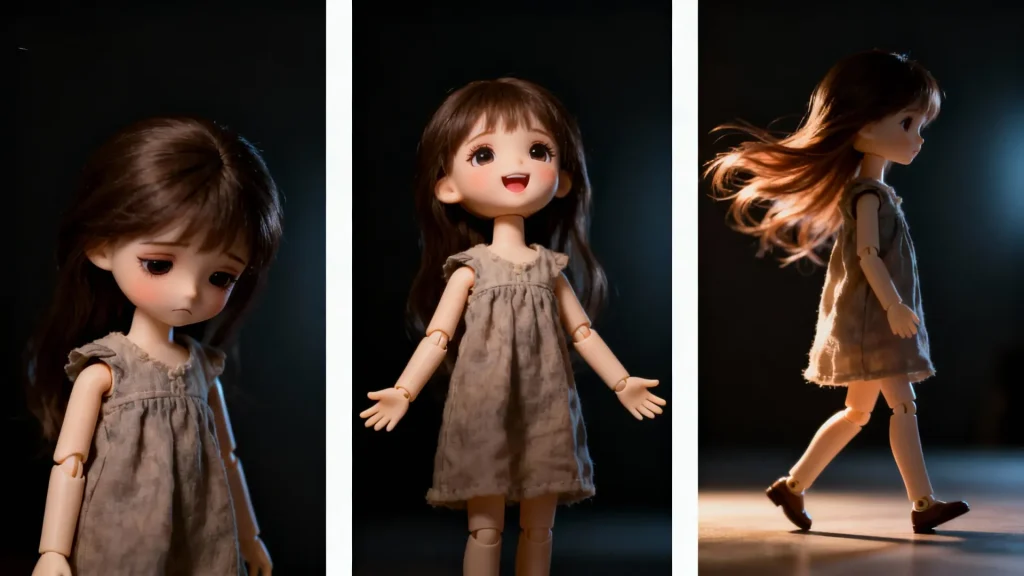
Capturing a Moment: Dynamic BJD Posing Ideas
Dynamic poses suggest movement, even if the doll is static. The key is to imply an action that is either just about to happen or has just finished.
- “About to Turn”: Twist the torso slightly, with one shoulder leading and the head turned in the direction of the implied movement. One foot might be slightly lifted or angled.
- “Wind-Swept Hair”: Tilt the head slightly back, with one arm gently raised as if brushing hair away from the face. The body can have a subtle lean.
- “Bending to Pick Up”: Gently bend the doll at the waist and knees, with one arm extended downwards. The focus here is on the body’s twist and the implied shift of weight.
Expert Insight: The secret to dynamic posing lies in creating asymmetry and suggesting a momentary imbalance. Think about how a human body moves – it’s rarely perfectly symmetrical when in action.
jointed muse’s Safety Alert
Dynamic poses, by their very nature, put more strain on your doll’s stringing and joints. While beautiful for photography, they should not be maintained for long periods. Always return your doll to a more relaxed, stable pose for long-term display to prevent accelerated wear and tear on the stringing and potential stress on the resin.
Posing for Emotion: Sadness, Joy, and Contemplation
This is where your doll truly comes alive. By understanding how subtle shifts in posture convey emotion, you can tell powerful stories.
- Sadness/Melancholy: A slight forward slump of the shoulders, a gentle tilt of the head downwards, perhaps hands clasped or resting in the lap. The spine’s curvature can be slightly more pronounced.
- Joy/Openness: Shoulders slightly back and open, head held high or tilted slightly upwards, arms perhaps outstretched or hands open. The chest cavity appears more expansive.
- Contemplation/Introspection: Head tilted to the side, one hand gently touching the chin or cheek, a slight lean forward. The neck joint and head tilt are crucial here.
Posing Don’ts: Hard Lessons from My Studio
I’ve learned many lessons over the years, some of them the hard way. Let me share a few “don’ts” to save you from similar close calls.
- The “Death V-Squat”: This is when a doll is forced into an extreme, deep squat where the knees are bent almost completely back, and the hips are pushed far forward. I’ll never forget the time I tried to get my first MSD doll into a “cool” action pose like this. The strain on her knee and hip joints was immense, and I heard a faint creak. Luckily, no permanent damage, but it was a stark reminder that just because a joint can move that far, doesn’t mean it should be held there. It puts incredible stress on the resin and stringing.
- The “180-Degree Arm Twist”: Some dolls have very flexible shoulder joints, allowing the arm to rotate almost completely. But forcing the arm to point directly backward, especially with the elbow bent, is a recipe for disaster. A hard lesson I learned with my first SD doll was trying to achieve an overly dramatic “reaching back” pose. The constant torque on the shoulder joint caused visible stress lines to appear after just a few hours. Always respect the natural rotation limits.
- The “Unsupported One-Leg Stand”: As emphasized earlier in our jointed muse’s Safety Alert, attempting any single-leg or highly dynamic pose without a proper stand is a significant risk. It’s simply not worth the potential for chips, cracks, or broken joints. Always use a stand for these ambitious poses.
- The “Head-Back Arch”: While a slight head tilt back can be expressive, forcing the head to arch so far back that the back of the head touches the doll’s back is dangerous. This puts extreme pressure on the neck joint and can cause stress lines or even crack the neck socket.
Your Questions, Answered: A Posing FAQ
Here are some common questions I receive in the atelier:
Q: How long can I leave my BJD in a dynamic pose?
A: I recommend no more than a few hours, especially for very dynamic or gravity-defying poses. For long-term display, always revert to a relaxed, stable pose, ideally with a stand. This minimizes strain on the stringing and joints.
Q: Can I pose my BJD without a stand at all?
A: For simple standing or sitting poses on a stable surface, yes, it’s absolutely possible and often preferred for a cleaner look. However, for any pose that involves significant balance, movement, or a single point of contact, a stand is mandatory for safety.
Q: What should I do if a joint feels too stiff or makes a cracking sound?
A: If a joint feels too stiff, do not force it. Check the stringing tension – it might be too tight. If you hear a cracking sound, stop immediately. Carefully inspect the joint for any visible damage or stress lines. If you find any, avoid posing that joint further and consider consulting an experienced BJD repair specialist.
Q: How do I prevent BJD damage when traveling with my doll?
A: Always transport your doll in a well-padded case. Disassemble larger dolls into their main body parts (head, torso, limbs) if possible, and wrap each part individually in soft cloth or bubble wrap. Ensure there’s no room for parts to shift or knock against each other. For smaller dolls, ensure they are securely nestled and cannot move freely within the case.
Conclusion: Your Journey of Expression Has Just Begun
Congratulations, you’ve taken the first step on a truly rewarding journey. Remember the core principles we’ve discussed: understand your doll’s anatomy, respect its delicate nature, and approach every posing session with patience.
Every time you gently adjust a limb, tilt a head, or position a hand, you’re not just moving resin; you’re engaging in a silent dialogue with your companion. You’re giving it a voice, a story, an emotion. Don’t be afraid to experiment, but always with safety as your guiding star.
The ultimate goal of this guide, and indeed of my entire atelier, is to empower you to safely unleash the soul within your doll. Your doll’s story is waiting to be told, and now, you have the confidence and knowledge to help it speak. Go forth, create, and enjoy every moment with these delicate beauties. Your journey of expression has just begun.Once you’ve created some beautiful poses, consider sharing your work with the welcoming BJD community!
BJD for Beginners: The Complete Guide
- A Parent’s Guide to Choosing BJD Dolls for Kids
- Your First BJD: The Ultimate Guide for Beginners (2025)
- What is a BJD Doll? A Guide to Your Next Obsession
- How to Get Into BJD: A Guide From a Long-Time Collector
- BJD Full Set: More Than a Doll, It’s a Story in a Box
- BJD Sizes Explained: The Ultimate Guide to Ball Jointed Doll Dimensions (2025)
- How to Buy Your First BJD: A Step-by-Step Guide for Beginners
- The Resin Guardian’s Handbook: A Lifelong Guide to BJD Care and Maintenance
- Awakening the Soul: A Philosophy for Customizing Your BJD
- BJD Accessories Guide: Crafting a Universe for Your Doll
- Joining the BJD Community: Your Warm and Welcoming Guide to Doll Collecting
- Unlocking the Soul: A Beginner’s Guide to BJD Photography Magic
- The Ultimate Guide to Buying & Selling Secondhand BJDs Safely & Smartly
- Navigating Your First BJD: An Empathetic & Realistic BJD Budget Guide for New Collectors
- Ultimate BJD Care Guide: Daily Habits to Prevent Yellowing & Damage
- BJD Eyes: The Ultimate Guide to Bringing Your Doll’s Soul to Life
- Master Indoor BJD Photography: Pro Tips for Magical Shots With Basic Gear
- BJD Unboxing 101: Your Step-by-Step Guide to a Joyful First Look
- BJD Posing Guide for Beginners: Express Emotion Without Damaging Your Doll (You are here)
- You’re Welcome to the BJD Community: A Guide to Sharing, Learning & Friends
- The Definitive BJD Secondhand Buying Guide: Spot Deals & Avoid Scams