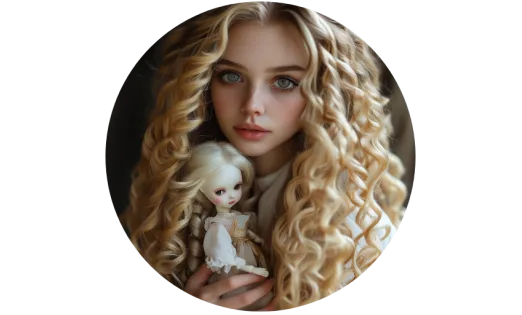
Every BJD owner knows the thrill of unboxing a new doll. As you admire the faceup and feel that spark of personality, one question always follows: what will they wear?
You look for outfits online, but nothing feels quite right. The style might be off, the fit uncertain, or your vision just isn’t available.
I’ve been there more times than I can count. My name is a whisper in old Den of Angels threads, and my sewing box reflects more than two decades of this incredible hobby. The most fulfilling journey you can take with your doll is learning to create for them. The key isn’t just sewing; it’s mastering the art of the pattern. Instead of resizing human patterns or relying on ill-fitting freebies, I’ll show you how to draft BJD clothing patterns from scratch—your guide to making BJD clothes that fit perfectly and bring your vision to life.
Why Bother Drafting Your Own Patterns?
In a world of pre-made outfits, why dive into the seemingly complex world of pattern drafting? For me, it comes down to three things: fit, freedom, and connection.
- The Sanctity of a Perfect Fit: No two BJDs are exactly alike. Even within the same company and sculpt, resin can shrink differently. A doll from 2010 might have slightly different proportions than one from 2024. When you draft a pattern directly on your doll’s body, you are guaranteeing a bespoke, couture fit that you simply cannot get anywhere else. No more gapping waistbands or sleeves that are just a little too tight.
- You are no longer just a consumer; you are a designer. Want to create a historical gown for your Soom Super Gem, a streetwear look for your Dollshe, or a delicate Mori-kei dress for your Minifee? When you can create the foundational pattern, any design is possible. The only limit is your creativity.
- There is nothing—and I mean nothing—in this hobby that connects you to your doll more than the act of creation. The hours spent wrapping their form, drawing seam lines, and stitching fabric together form a conversation. You learn every curve and nuance of their shape. The finished garment isn’t just an accessory; it’s a piece of your shared story.

Your Pattern-Drafting Arsenal: The Essential Toolkit
Before we get started with this BJD doll clothes tutorial, let’s gather our supplies. You don’t need a professional fashion design studio—just a few key items will do.
The Non-Negotiables
- Plastic Wrap: The first protective layer.
- Masking or Painter’s Tape: 1 inch wide. Painter’s tape is less sticky.
- Fine-Point Permanent Marker: For marking pattern lines clearly.
- Sharp Scissors: Use small ones for cutting off the doll, and another pair for paper only.
- Paper: Printer paper works, pattern paper is optional.
- Flexible Measuring Tape: Use a sewing type, not metal.
The “Level-Up” Tools
- French Curves: Clear rulers for smoothing curves like armholes.
- Clear Gridded Ruler: For straight seam allowances.
- Pencils and Eraser: For refining patterns on paper.
The Core Technique: The “Mummy Wrap” Method Step-by-Step
This is the heart of custom pattern making. We are going to create a perfect mold of your doll’s torso (or leg, or arm) that we can then turn into a flat, reusable pattern. Let’s start by making a simple, sleeveless bodice.
Step 1: Prepare Your Muse
Before you begin, let’s move into preparing your doll for the drafting process. First, protect your doll. Remove their wig and head (it makes it easier to work around the neck). If you’re especially worried about their faceup, cover it with a soft cloth or a bit of plastic wrap. Make sure your doll is standing or sitting securely.
Step 2: The First Layer – Plastic Wrap
Next, it’s time to apply the first protective layer to your doll. Tear off a piece of plastic wrap and wrap it snugly around your doll’s torso, from the underarms to the hips. You want it to be smooth and tight, but not so tight that it’s compressing the body. Overlap the wrap so it holds itself in place.

Step 3: The Second Layer – The Tape Shell
With the plastic wrap in place, move on to the second layer. Now, tear off small pieces of masking tape (about 1–2 inches long) and apply them over the plastic wrap. Cover the entire area with overlapping pieces of tape.
- Tip: Apply the tape in different directions—horizontally, vertically, diagonally. This creates a strong, stable “shell” that won’t warp when you remove it. Make sure the entire plastic-wrapped area is covered in at least two layers of tape. It should feel firm, like a little cast.
Step 4: Draw Your Design Lines
Once your tape shell is complete, it’s time to design your pattern lines. Take your fine-point marker and draw the “map” for your pattern pieces. For a basic bodice, draw:
- Center Front (CF): A straight line down the very middle of the front, from the neckline to the waist.
- Center Back (CB): A straight line down the very middle of the back. This is often where your closure will be.
- Neckline: Draw the shape of the neckline you want (e.g., jewel, scoop, V-neck).
- Armholes: Carefully draw the curve where the sleeve would join the body.
- Shoulder Seams: A line across the top of the shoulder, connecting the front and back neckline to the armhole.
- Side Seams: A line running down the side of the doll, from the armpit to the waist.
- Waistline: A line around the doll’s natural waist.
You have now drawn the pieces for a front bodice and two back bodice halves right onto your doll!
Step 5: The “Surgery” – Cutting the Pattern Off
After your design lines are drawn, carefully move on to removing the pattern from your doll. Take your small, sharp scissors. Very, very carefully, cut the tape shell off the doll. I recommend cutting along the Center Back line and the shoulder seams. This usually allows you to gently peel the entire shell off in one or two large pieces. Once it’s off the doll, continue cutting along the other seam lines you drew (side seams, etc.). You should now have a few curved, tape-and-plastic pieces: one Front Bodice and two Back Bodice halves.
Step 6: From 3D Shell to 2D Pattern
Your tape pieces are curved because your doll is curved. To make a flat pattern, we need to address this.
- With the shell removed, shift your focus to flattening your new pattern pieces. Lay a piece (let’s say the Front Bodice) on your paper. You’ll notice it doesn’t lie flat.
- To address the curve, make relief cuts. To make it flat, you need to cut one or more small slits, called “darts” or “relief cuts,” from the edge into the body of the pattern piece. For a bodice, these are common at the bust. Cut from the waistline up towards the fullest part of the bust, stopping just short of the center.
- After relief cuts, lay your piece flat and tape it to the paper. The overlapping gap you created is your bust dart. Tape the pattern piece securely.

Step 7: Tracing, Refining, and Adding Seam Allowance
Now, move to the step of tracing and refining the pattern. Trace around your taped-down piece with a pencil. Now, remove the tape piece and refine your pencil lines. Use your French curves to smooth out the armhole and neckline. Use a straight ruler to true up the side seams and center front.
Once you’ve refined the outline, the next step is to add seam allowance. This next part is very important: you need to add a little extra space around the edge. This is for where your fabric will be sewn together. For most BJD clothes, add about 1/4 inch (or about 6mm) around your pattern. Use your clear ruler to draw a new line outside your traced pattern to show where to cut.
To complete your drafted pattern, label each piece clearly. Label your piece clearly: “Front Bodice – Cut 1 on Fold,” “Back Bodice – Cut 2.” Congratulations. You have just drafted your first custom BJD clothing patterns.
Applying the Technique to Other Garments
Once you master the bodice, the world opens up. Here’s how to approach other common garments.
Drafting Basic Trousers
This is one of the most rewarding patterns to draft because a good fit in pants is so hard to find.
- Wrap each of your doll’s legs individually, from the waist down to the ankle.
- Draw your lines: the waistline, the outseam (the outside of the leg), the inseam (the inside of the leg), and the hemline at the ankle.
- The Crotch Curve: This is the most important part. Draw a “J” shaped line from the Center Front at the waist, down and under the crotch, and up to the Center Back at the waist.
- Carefully cut the shell off along the inseam and outseam. You will have a front pant piece and a back pant piece for each leg.
- Flatten them onto paper, making small relief cuts as needed along the curved areas of the hip and thigh.
- Trace, refine, and add your seam allowance. The secret to professional-looking BJD clothes often lies in a perfectly drafted pair of pants.
Drafting a Simple Sleeve
- Take your finished bodice pattern pieces (front and back) and tape them together at the side seam.
- Use your flexible measuring tape to measure the entire length of the armhole curve on your pattern. Write this number down.
- Wrap your doll’s arm in tape. Draw the shoulder line, the underarm seam, and the wrist line. Cut it off.
- Flatten this piece. The top curve is your “sleeve cap.” The length of this curve needs to match the length of the armhole you measured in step 2. You can adjust the curve to make it higher (for a puffier sleeve) or flatter—as long as the length matches. This is a core principle of pattern making.

Pro BJD Sewing Tips from the Trenches
Drafting the pattern is half the battle. Here are some hard-won bjd sewing tips to help you with the construction.
- Always Make a Test Garment: A “test garment” (or a “practice piece”) is a first try made from cheap fabric. ALWAYS do this. It helps you check if your clothes will fit well and lets you fix your paper pattern before you use your expensive or special fabric.
- Mind the Scale: Human-sized prints will look giant and out of place on a doll. Look for fabrics with tiny, small-scale prints. Use lightweight fabrics like cotton lawn, thin silks, and voile. Heavy denim or corduroy is often too bulky. Use fine, lightweight thread as well.
- Press Your Seams: A mini craft iron is one of the best investments you can make. Pressing every seam open as you sew is the single biggest difference between a homemade-looking garment and a professional one.
- Finish Your Edges: Tiny fabric edges can come undone easily. Putting a little bit of liquid seam sealer on the cut edges inside the garment works well. Or, you can use zigzag scissors to stop the fabric from coming apart.
- Choose Your Closures Wisely: The best closures are the smallest ones. Look for tiny snaps (size 4/0 or 5/0), small hook-and-eye closures, or very thin, soft Velcro. Avoid bulky buttons and zippers unless they are a specific design feature.
Your Journey as a BJD Couturier
The path to becoming a confident creator for your dolls is a journey paved with practice, patience, and a few seam-ripped mistakes. Don’t be discouraged if your first attempt isn’t perfect. Every piece you make, every pattern you draft, teaches you something new.
You’ve moved beyond simply owning a beautiful object. You’ve become its partner in storytelling, its personal couturier. By taking the time to learn their form and create for them, you are breathing a unique life into the resin, a life that only you can provide. So take out that roll of tape, embrace the process, and get ready to discover the most rewarding part of the BJD hobby. Now you truly know how to make bjd clothes that are a perfect expression of your doll’s soul—and your own.
BJD Fashion & Styling: The Complete Guide
- How to Make BJD Clothes: A Pro’s Pattern Drafting Guide (You are here)
- The Ultimate BJD Fashion Guide: Curating the Perfect Look for Your Doll (2025)
- Gothic BJD Dresses: The Ultimate Dark Romance Guide