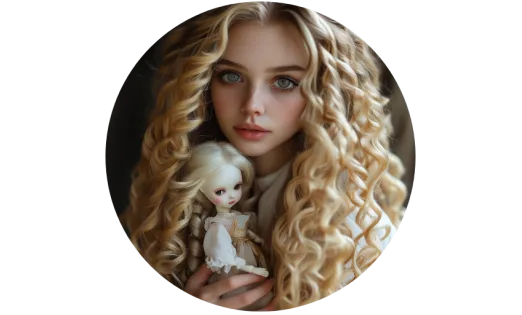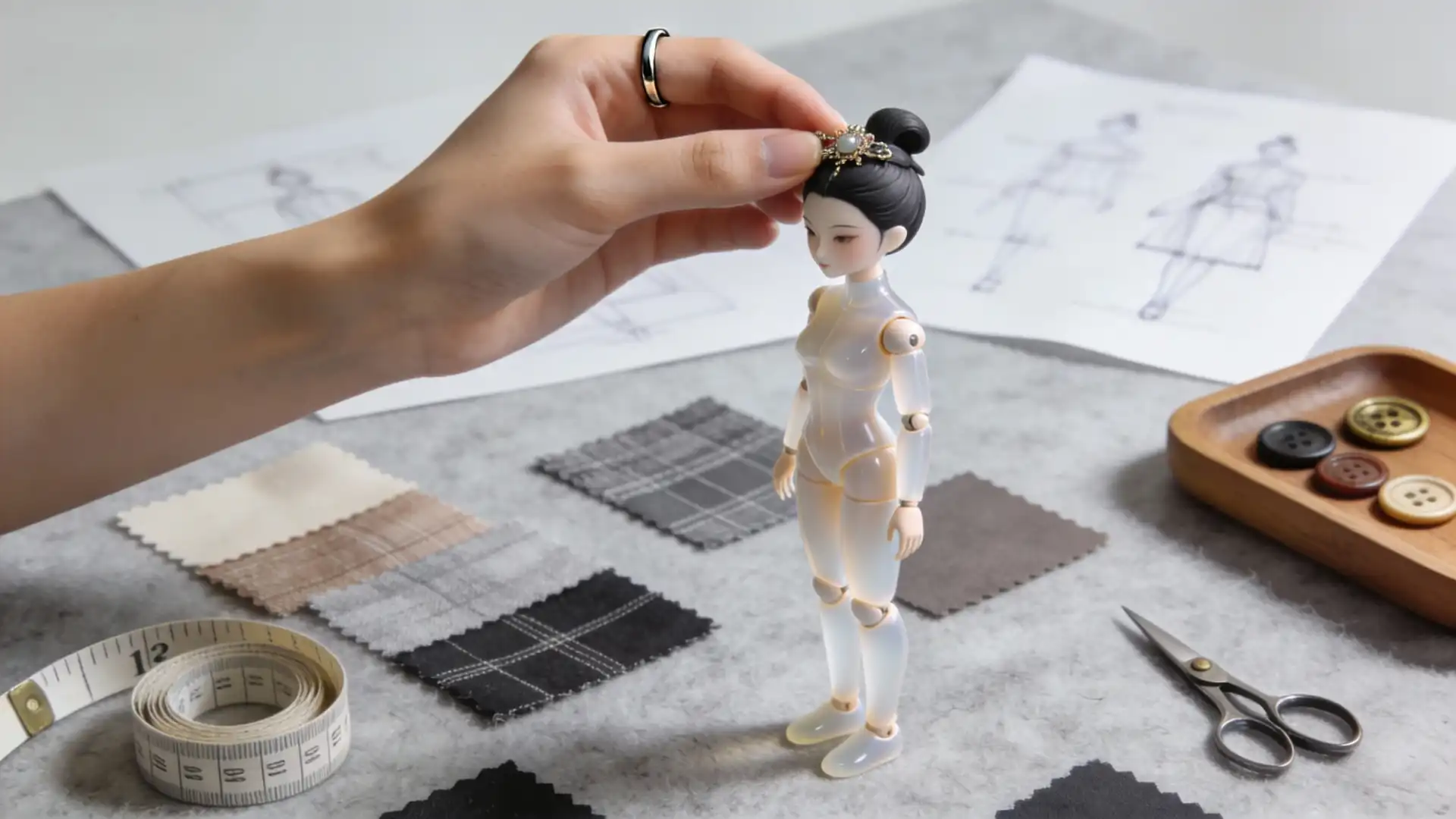
BJD fashion is the process of building a coherent visual identity for a ball-jointed doll through clothing, wigs, eyes, shoes, accessories, fabric safety, and scale-accurate fit. A strong BJD outfit should match the doll’s sculpt, face-up, body proportions, resin skin tone, and character concept while protecting the resin from staining, pressure marks, and long-term material damage.
This guide explains how to style SD, MSD, YoSD, 70cm, mature mini, and fantasy BJDs using a practical framework: diagnose your doll’s Style DNA, choose resin-safe fabrics, check measurements before buying, build outfits around a character narrative, and store clothing safely after display or photography.
There is a singular moment in this hobby that we all chase. It is not only the unboxing, and it is not even the face-up. It is that moment when you step back, look at your doll, and realize: “Yes. This is exactly who you are.”
After years in the hobby, dealing with everything from limited fantasy sculpts to classic SD bodies, I have learned that styling is not just “dressing up.” It is character building. A doll without a coherent style can feel like resin on a shelf. A styled doll becomes a character, a muse, and a piece of art.
But I know the struggle. You open a drawer full of expensive tiny clothes, yet your doll still looks slightly wrong. Or worse, you hesitate to dress your doll at all because you are afraid of staining that pristine resin.
Welcome to your mentorship. In this guide, we are not just shopping. We are curating.
What You’ll Master
Style DNA Diagnosis: How to stop buying beautiful pieces that do not match your doll’s sculpt, face-up, body type, and character.
Scale and Fit Control: How to measure SD, MSD, YoSD, mature mini, and 70cm bodies before buying clothes.
Fabric Safety: A practical 2025-2026 protocol for reducing resin staining from black, red, navy, denim, velvet, synthetic fabrics, and dark wigs.
Outfit Architecture: How to build a complete look using silhouette, color, texture, wig, shoes, eyes, and one narrative accessory.
Smart Sourcing: How to compare high-end makers, dealer basics, Taobao or agent finds, and handmade listings without falling for stolen photos or unsafe materials.
Wardrobe Maintenance: How to store dark clothing, wigs, metal accessories, leather, and faux leather after photoshoots or long-term display.
Beyond Dressing Up: Understanding Your Doll’s Style DNA
Why does a $200 gothic dress look breathtaking on one doll and like a cheap costume on another?
The answer lies in Style DNA.
The biggest pain point I see with newer collectors is what I call “Magpie Syndrome”: buying beautiful shiny things that have nothing to do with each other. The result is a wardrobe full of stunning pieces that never form a coherent character.
BJD styling improves when you stop asking, “Is this outfit pretty?” and start asking, “Does this outfit belong to this doll?”
Decoding the Sculpt
Before you buy another item, look carefully at your doll’s face-up, sculpt, and body lines.
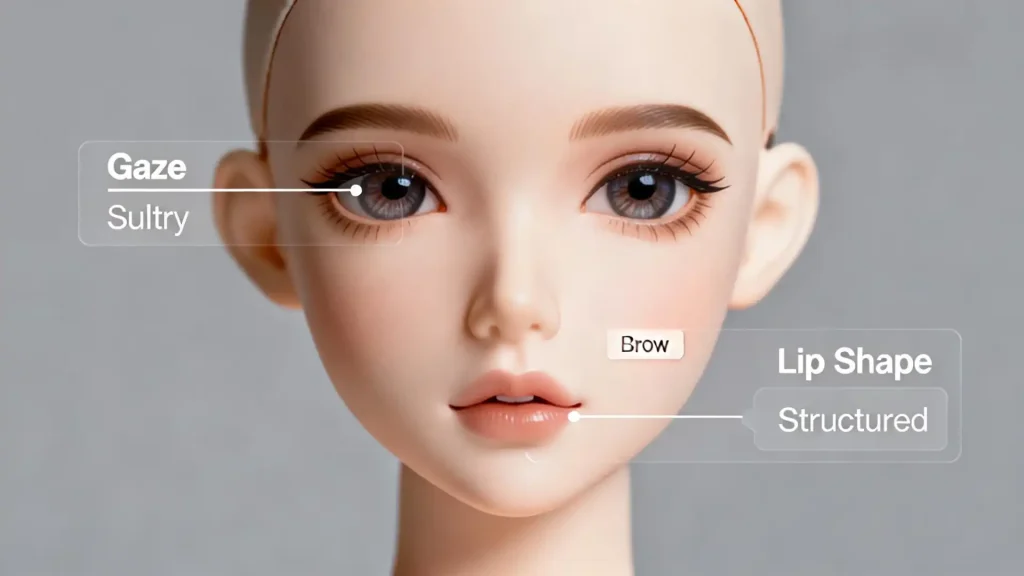
The Gaze: Are the eyes heavy-lidded, mature, and sultry? Or are they wide, round, and innocent? A heavy-lidded SD may look elegant in velvet, long coats, and muted colors, but strangely grumpy in bright frilly cotton.
The Lips: A sharp, thin lip can suggest seriousness, nobility, or severity. That kind of sculpt often works well with structured tailoring, high collars, boots, and monochrome palettes. A soft glossy pout usually asks for softer textures such as knits, chiffon, lace, or layered skirts.
The Body Type: Is the body slender and elongated? It may need draped fabrics, long lines, and editorial silhouettes. Is the body broad, muscular, or stockier? It often benefits from structured denim, leather, fitted jackets, or boots that give the body visual weight.
Quick Style DNA Diagnosis Table
| Feature to Read | What It Suggests | Styling Direction |
|---|---|---|
| Heavy-lidded eyes | Mature, tired, elegant, mysterious | Tailoring, dark neutrals, velvet, long coats, restrained jewelry |
| Wide round eyes | Youthful, innocent, energetic | Softer colors, rounded shoes, cotton, knits, playful accessories |
| Sharp lips or strong jawline | Severe, noble, intellectual, dramatic | Structured jackets, collars, monochrome outfits, boots |
| Soft lips and gentle face-up | Romantic, dreamy, approachable | Chiffon, lace, layered skirts, soft wigs, warm neutrals |
| Long slender body | Elegant, fragile, editorial | Draped fabrics, long lines, narrow trousers, oversized coats |
| Muscular or broad body | Physical, grounded, heroic | Denim, leather, fitted jackets, heavier boots |
| Fantasy parts or horns | Non-human, mythic, ceremonial | Asymmetry, metal details, layered fabric, weathered textures |
This table is not a rulebook. It is a diagnostic tool. The goal is not to trap your doll inside one aesthetic, but to understand what the sculpt naturally supports.
Narrative Styling
Do not just dress the body. Dress the life.
Create a two-sentence backstory for your doll before shopping.
Bad example:
“She likes fashion.”
Better example:
“She is a 2025 urban botanist who lives in a rainy cyberpunk city and collects vintage lace.”
Now, when you shop, you can ask better questions:
Would a botanist wear this?
Does this fit a rainy city?
Does this fabric feel vintage, futuristic, practical, or ceremonial?
This creates aesthetic coherence.
A useful styling rule is to give every outfit one controlled contrast. If the sculpt is soft, add one sharper element such as boots, a harness, a structured coat, or metal jewelry. If the sculpt is severe, soften it with a loose knit, a pale wig, or a translucent layer. Perfect matching can make a doll look flat; controlled contrast makes the character feel designed.
The Expert’s Heart
For me, once I decided one of my mature male dolls was a “retired interstellar cartographer,” shopping for him changed from a chore into an archaeological dig. I was not just buying a grey coat. I was looking for the wear and tear of stardust on the hem.
It gave every purchase a reason to exist. It transformed him from a doll into a story.
2025-2026 Aesthetic Notes: What Is Actually Useful for BJD Styling
Trends are useful only when they help the doll.
For 2025-2026 BJD styling, the most practical shift is not one single aesthetic. It is better mixing: soft with hard, antique with futuristic, handmade with technical, fantasy with realistic wear.
Cyber-Romanticism
Cyber-romantic styling works because it gives contrast: lace against buckles, soft wigs against metal accessories, old-world silhouettes against mechanical props.
Think Neo-Victorian lace, corsets, layered skirts, straps, techwear buckles, translucent fabrics, and small metallic details.
Hyper-Texture
Small-scale dolls need visible material contrast under camera light. Knit, lace, weathered cotton, faux leather, metal, chiffon, linen, and 3D printed accessories each create different visual weight.
This is why a simple outfit can look expensive if the textures are chosen well.
Desaturated Palettes
Dusty, muted colors usually photograph better on resin than pure primary colors.
Instead of bright red, try oxblood or burgundy.
Instead of bright blue, try slate, petrol, or muted navy.
Instead of pure yellow, try mustard, antique gold, or cream.
This does not mean saturated colors are wrong. They work beautifully for anime-inspired, playful, idol, or fantasy characters. But for realism and photographic depth, desaturated palettes are often easier to control.
Choosing Colors for Resin Skin Tones
Resin skin tone changes how clothing colors read on camera and in display. The safest approach is to choose colors that support the sculpt instead of overpowering it.
Normal skin often works well with muted blue, olive, burgundy, ivory, charcoal, dusty rose, and warm brown.
White skin usually looks strong with cool grey, silver, ice blue, lavender, ivory, black accents, and low-saturation pastels. Be careful with long-term contact from dark wigs, black collars, and tight black clothing.
Tan skin often benefits from cream, gold, deep green, warm brown, rust, teal, and off-white. Strong jewel tones can look excellent, but dark dyes still need testing.
Grey or fantasy resin can handle monochrome, metallics, desaturated purple, bone white, black, and unusual accent colors.
Avoid using highly saturated primary colors unless the doll is meant to look anime-styled, playful, or intentionally artificial. On many resin sculpts, dusty and muted colors photograph more naturally than pure red, pure blue, or pure yellow.
The Foundation: BJD Fashion Essentials Decoded
Aesthetically pleasing is good. Chemically safe is better.
Nothing ruins the hobby faster than lifting a wig and finding a deep purple stain on your doll’s headcap, forehead, neck, or shoulders.
Fabric Science and Safety
Resin is porous. Over time, it can absorb dye from fabric, wigs, leather, thread, elastic, and even some accessories.
Staining risk is not caused by color alone. It is the result of five variables:
dye strength, fabric type, contact time, pressure, and environment.
A loose black cloak worn for a 20-minute photoshoot is far safer than tight black leggings left on a doll for three months in a warm display cabinet.
BJD Fabric and Material Safety Table
| Fabric or Material | Visual Effect | Staining Risk | Long-Term Wear? | Best Practice |
|---|---|---|---|---|
| Dark denim | Stiff, casual, realistic | Extreme | No | Wash separately, test repeatedly, use pale lining |
| Black cotton or jersey | Clean casual lines | High | Usually no | Use a body stocking or pale underlayer |
| Silk or chiffon | Light, flowing, elegant | Low to medium | Maybe | Test dyed silk; avoid unknown dark colors |
| White or natural linen | Natural, slightly rustic | Very low | Usually yes | Good base layer, but check buttons and trims |
| Red or maroon velvet | Heavy, formal, dramatic | Extreme | No | Photoshoot-only unless fully lined and tested |
| Faux leather or PU | Modern, gothic, cyber | Medium to high | No | Watch for stickiness, cracking, dye transfer |
| Metal chains or charms | Adds realism and weight | Surface mark risk | Short-term only | Avoid direct contact with face, neck, hands |
| Dark wigs | Strong character framing | High on headcap and forehead | No | Use a pale wig cap and check often |
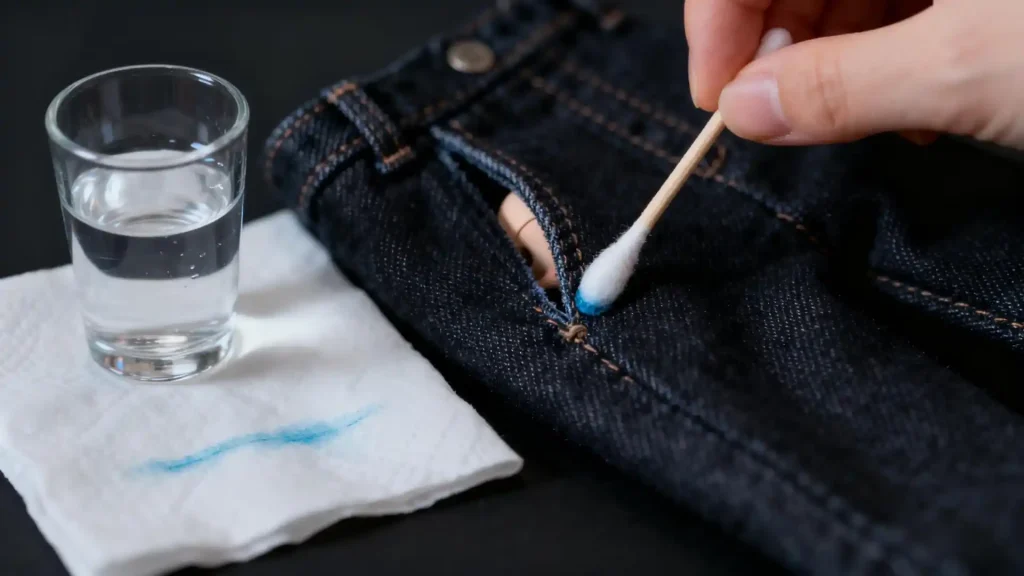
Pro Tip: The 3-Step Dye Transfer Test
Before putting a new dark item on your doll, test it.
1. Dry Rub Test
Rub a white cotton pad against the inside seam, waistband, collar, dark lining, or wig fibers. If color transfers when dry, do not put it directly on resin.
2. Damp Swab Test
Lightly dampen a cotton swab with cool water and rub the same hidden areas. If the swab picks up dye, the garment needs washing, lining, or photoshoot-only use.
3. Pressure Test
Place the damp tested area against a piece of white cotton or paper towel under light pressure for 30-60 minutes. This better simulates tight sleeves, waistbands, leggings, collars, and socks.
If a garment fails any of these tests, wash it separately in cool water with mild detergent, dry it completely, and test again. Some black, navy, red, burgundy, and denim dyes may continue to transfer even after washing. Those pieces should be treated as photoshoot-only or worn over a resin-safe barrier layer.
Avoid assuming vinegar will fix every dye problem. Vinegar may help with some dyes and fibers, but many BJD clothes use synthetic fabric, mixed fibers, trims, glue, metal parts, or unstable dyes. Testing matters more than guessing.
BJD Size Compatibility: Why Scale Alone Is Not Enough
BJD clothing size is not determined by scale alone.
Labels like 1/3, SD, MSD, YoSD, or 70cm are only starting points. A fitted shirt, corset, coat, or pair of trousers must match the actual body measurements.
Two dolls can both be “1/3 scale” and still have completely different clothing needs. An SD13 boy, SD17 boy, 70cm muscular body, slim mature male body, curvy female body, and fantasy body may not share jackets, trousers, or shoes safely.
Before buying, check:
- seller’s model doll
- flat garment measurements
- shoulder width
- bust or chest
- waist
- hip
- sleeve length
- inseam
- fabric stretch
- closure method
If the listing only says “fits SD” without measurements, treat it as incomplete information.
Measurements That Matter
| Measurement | Why It Matters |
|---|---|
| Shoulder width | Coats, shirts, jackets, uniforms |
| Chest or bust | Dresses, corsets, button-up shirts |
| Waist | Skirts, trousers, belts |
| Hip | Fitted pants and bodycon dresses |
| Arm length | Long sleeves and gloves |
| Inseam | Trousers, leggings, stockings |
| Foot length and width | Boots and shoes |
| Neck circumference | Collars, chokers, high-neck tops |
| Head circumference | Hats, hoods, wig styling |
The Golden Ratio of Fit
Scale is everything.
In BJD clothing, the thickness of thread, fabric, lining, and seams matters. A human sweater knit can look like giant rope on an MSD doll. A bulky lining can destroy the shoulder line of a tiny jacket. A shoe that is only slightly too large can make the entire doll look unstable.
If a garment gaps at the waist or slides during posing, adjust the clothing rather than the resin. Use removable padding inside the garment, a white cotton underlayer, acid-free paper tape on the inside of the clothing, or a temporary stitch.
Avoid putting ordinary masking tape directly on resin, blushing, body paint, or sealant. Adhesive can leave residue or marks, especially over time.
The 5-Part Outfit Architecture
A complete BJD outfit usually needs five layers of decision-making.
1. Silhouette
This is the overall shape from head to toe.
Long and narrow feels elegant.
Cropped and wide feels energetic.
Asymmetrical feels fantasy, editorial, or unstable in an intentional way.
2. Texture
Resin can look flat under camera light, so texture matters.
Knit, lace, weathered cotton, leather, metal, chiffon, velvet, and linen each create different visual weight.
3. Color Palette
Use two to three main colors, then one accent.
Too many saturated colors can make a resin doll look toy-like unless that is the intended style.
4. Face Framing
Wig shape, eye color, glasses, earrings, collars, hats, and hoods change how the face-up reads.
A wig can make a doll look older, younger, colder, sweeter, softer, or more severe without repainting the face.
5. Story Prop
One object should explain the character.
A book, headset, staff, camera, sword, flower case, medical bag, mechanical part, violin, or suitcase can make an outfit feel like a life instead of a costume.
If an outfit looks expensive but still feels wrong, one of these five layers is usually missing or fighting the others.
Curating in Action: Building Complete BJD Outfits
Now let’s assemble. We move from buying items to building concepts.
The “Effortless” Daily Look
The hardest look to pull off is casual.
If you simply put a T-shirt and jeans on a doll, they can look like a toy. Casual styling needs texture, proportion, and one intentional character detail.
Micro-Case Study: The Off-Duty Android
Doll: Luts Senior Delf or similar realistic/cyber sculpt
Concept: A robot trying to blend into street culture
The Kit:
- Oversized distressed grey knit sweater for texture and weight
- Black leggings with paneling lines to echo mechanical joints
- Chunky headset or collar to break the neck line
- Sleeves pushed up to expose wrist joints intentionally
- Muted sneakers or heavy boots, depending on whether the character feels stealthy or industrial
Why it works:
The outfit uses casual clothing, but the paneling, exposed joints, and headset keep the android concept alive.
Fantasy and Theme Construction
If you are building a fantasy look, avoid the “Halloween Store” effect.
Fantasy styling becomes stronger when it includes believable materials, uneven layering, weathering, and a reason for each object to exist.
Micro-Case Study: The Cyber-Romantic Forest Guardian
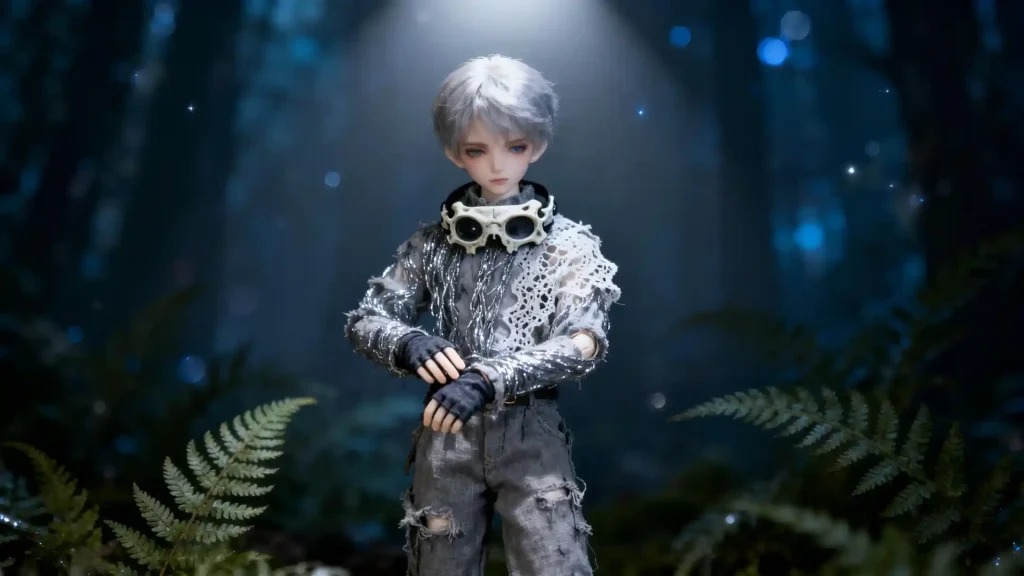
Doll: Soom fantasy sculpt or any horned, hooved, winged, or non-human BJD
Concept: A cyber-romantic forest guardian
The Kit:
- Weathered grey linen trousers dyed or toned to feel earthy
- Lace top interwoven with silver jewelry wire to suggest magical circuitry
- 3D printed bone-like goggles, antlers, halo, or mask
- Sheer tattered scarf draped unevenly over one shoulder
- Boots or foot wraps that feel practical rather than decorative
Why it works:
The look blends organic and mechanical details. It does not just say “forest.” It says this character lives between nature, ritual, and technology.
Why BJD Outfits Look Different in Photos Than in Real Life
BJD styling is partly camera styling.
A look that feels balanced in hand can look flat in photos. A slightly exaggerated accessory may look perfect through a lens.
For photography, prioritize:
- visible texture
- clean silhouettes
- intentional hand placement
- one readable focal point near the face
- controlled color contrast
Avoid tiny details that disappear on camera unless they support a close-up shot.
If the outfit is for display, comfort and long-term resin safety matter more than dramatic layering. If the outfit is for a photoshoot, you can take more visual risks, but you should remove high-risk items afterward.
Photoshoot vs Long-Term Display Safety
| Use Case | Safer Choices | Higher-Risk Choices |
|---|---|---|
| Quick photoshoot | Dark outfits with barriers, metal props, layered styling | Tight black sleeves, dark wigs without wig caps |
| One-day display | Pale underlayers, tested clothing, loose silhouettes | Red velvet, denim, tight dark socks |
| Long-term display | White cotton, natural linen, pale proven-safe outfits | Black leggings, dark wigs, PU leather, metal touching resin |
| Storage | Clothes stored separately by color and material | Dark clothes pressed against pale garments or resin |
Your 2025-2026 Sourcing Toolkit: Shopping Smart
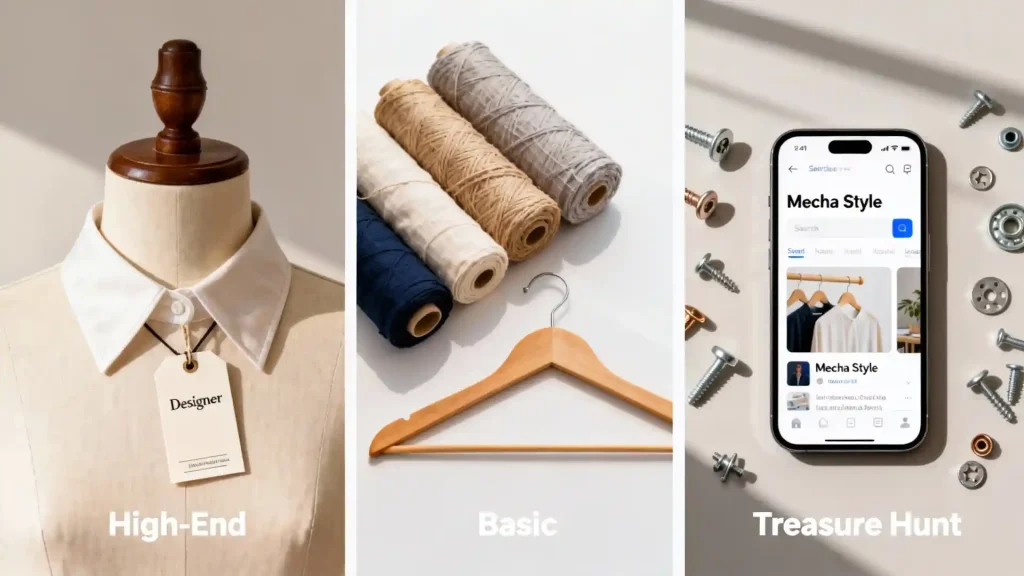
The market is flooded.
Between high-end drops, dealer basics, Taobao finds, Etsy handmade listings, and mass-produced filler, where do you find the good stuff?
The High-End Artist or Brand Maker
Examples include established BJD fashion makers known for tailoring, historical wear, formalwear, or full outfits.
Best for:
Tailored suits, corsets, coats, historical dresses, uniforms, and complex layered looks.
Important note:
Many established makers use better linings and more accurate patterns, but you should still test dark fabrics and check customer photos. Expensive does not automatically mean stain-proof.
Reliable Basics
Examples include dealer shops and long-running BJD retailers that carry underwear, basics, socks, simple jeans, shoes, and wigs.
Best for:
Neutral base layers, underwear, basic tees, pale shirts, simple trousers, socks, and backup pieces.
Search ideas:
“BJD basic set”
“SD white shirt”
“MSD cotton pants”
“YoSD shoes”
“BJD body stocking”
Taobao and Agent Finds
This is where many current styling trends appear quickly.
Useful search concepts include:
- BJD mecha style
- BJD techwear
- BJD deconstructed outfit
- BJD irregular hem
- BJD cyber style
- BJD gothic outfit
- BJD functional wind
- BJD handmade clothes
Use a shopping agent if needed, and always check measurements, seller photos, reviews, and whether the outfit was shown on a named doll body.
How to Judge a BJD Clothing Listing Before Buying
| Listing Detail | Good Sign | Warning Sign |
|---|---|---|
| Model doll named | Seller lists sculpt or body used | Only says “fits SD” or “fits 1/3” |
| Measurements | Shoulder, bust, waist, hip, length included | No cm measurements |
| Fabric information | Cotton, linen, silk, polyester, PU clearly listed | “High quality fabric” with no detail |
| Inside photos | Shows lining, seams, closures | Only front beauty shots |
| Customer photos | Real owner photos available | Only official-looking images |
| Dark fabric warning | Seller mentions washing or lining | No warning for black, red, or denim items |
| Closure method | Snaps, hooks, zipper, elastic described | No explanation of how it goes on |
| Communication | Seller answers measurement questions | Refuses extra photos or details |
Honesty Check: Avoid Recasts and Stolen Photos
Do not buy from shops that sell recast dolls or rely on stolen company photos.
Beyond the ethical issue, these listings often come with practical risks: inaccurate sizing, poor patterning, unsafe dyes, misleading full-set photos, and no reliable after-sales support.
A low price is not automatically a scam. But a “full set” outfit that looks identical to a limited company release, uses official promotional photos, has no real garment measurements, and costs a fraction of the normal price should be treated as high risk.
Red Flags
Stock photos only: If a seller only uses official company promotional shots but claims the outfit is handmade, be careful.
One size fits all: In BJD fashion, this is rarely true. An SD13 boy and SD17 boy can have very different shoulder widths, chest measurements, and leg lengths.
No real measurements: A listing without measurements is a gamble.
No inside photos: The outside may look beautiful, but staining often comes from linings, seams, elastic, and thread.
After the Photoshoot: Safe Outfit Maintenance
After styling or photographing your doll, remove high-risk items instead of leaving them on by habit.
Check the headcap, forehead, neck, shoulders, elbows, waist, knees, ankles, and feet for early signs of dye transfer or pressure marks.
Store dark clothing separately from pale clothing. Keep denim, red velvet, black knits, leather, faux leather, and metal accessories in separate bags or compartments.
Do not store dark wigs pressed against pale wigs. Do not leave metal chains tightly wrapped around hands, necks, or ankles.
For long-term display, choose pale, tested clothing with loose contact points. If the look requires black, red, navy, or leather, treat it as a styled display that should be checked regularly rather than a permanent outfit.
The Expert’s Quick-Start Workflow: From Box to Gallery
Do not know where to start? Follow this checklist for every new doll or outfit.
Step 1: The Diagnosis
Analyze the face-up. Is it angry, soft, dreamy, severe, mature, or playful?
Analyze the body. Does it need structure such as denim, leather, tailoring, and boots? Or does it need flow such as silk, rayon, chiffon, linen, and draping?
Step 2: The Narrative
Write the two-sentence story for the character.
The story does not need to be complicated. It only needs to give your shopping decisions a direction.
Step 3: The Safety Audit
Perform the dry rub, damp swab, and pressure dye-transfer tests on dark fabric, denim, velvet, red fabric, black wigs, and dark linings.
Check whether any metal, leather, PU, or painted accessory touches resin directly.
Decide whether the outfit is safe for long-term display or only for photoshoots.
Step 4: The Plan
List three core items needed.
Example:
- one coat
- one pair of trousers
- one specific prop
Then list one statement accessory, such as boots, jewelry, glasses, a bag, a staff, a headset, or a weapon.
Step 5: The Source
Search specific tags on agent sites, check reliable dealer basics, or browse established artist makers.
Do not buy only because the item is beautiful. Buy because it fits the doll’s measurements, story, and safety needs.
Step 6: The Adjustment
Fit the clothes on the doll and check shoulder seams, waist gaps, sleeve length, sitting range, and hand clearance.
Use removable padding inside the garment, temporary stitches, or a pale underlayer to fix gaps.
Final touch: remove one accessory if the face no longer has a clear focal point.
Quick-Fire Q&A: Your Top BJD Styling Questions, Answered
Q: I just got my first BJD and my budget is tight. What should I buy first?
A: Skip the elaborate gown for now. Buy a reliable basic set in a neutral pale color such as white, ivory, beige, or grey. Then spend your remaining budget on one good wig and one pair of well-fitted shoes.
Good shoes and hair can elevate a basic outfit. A cheap wig can ruin a beautiful dress.
Q: What makes a BJD outfit look realistic?
A: A realistic BJD outfit usually has correct scale, clean shoulder fit, thin enough fabric, controlled color, believable shoes, and one clear character detail.
The fastest way to make a doll look toy-like is to use fabric that is too thick, colors that are too saturated, or accessories that do not match the sculpt’s expression.
Q: Can BJD clothes permanently stain resin?
A: Yes. Dark dyes can migrate into resin, especially under pressure, heat, humidity, or long contact time.
Fresh surface marks may be reduced with careful cleaning, but deep stains can be difficult or impossible to remove completely. Prevention is safer than repair.
Q: Should I wash BJD clothes before dressing my doll?
A: Wash and test high-risk items such as black clothing, red fabric, denim, velvet, dark socks, dark wigs, and unknown handmade pieces.
Light natural fabrics are usually safer, but trims, linings, thread, elastic, and metal parts should still be checked.
Q: I love the gothic look, but I am terrified of staining my doll. How do I do it safely?
A: Use a resin-safe protective barrier such as a pale body stocking, white underlayer, or safe lining. Treat deep velvet, black denim, black socks, dark wigs, and tight black clothing as photoshoot-only unless you have tested them repeatedly.
Do not leave your doll in a black gown or dark wig for months in a display cabinet without checking.
Q: Why do clothes marked “SD size” not fit my doll?
A: “SD” is a broad size category, not a precise measurement.
Shoulder width, chest, waist, hip, arm length, leg length, and foot size vary widely between SD10, SD13, SD17, 60cm, 65cm, 70cm, slim, mature, and muscular bodies.
Always compare actual measurements before buying.
Q: How do I transition my doll from cute to dark without repainting the face?
A: Use low-saturation colors as a bridge. Do not jump straight to black.
Try dusty rose, slate grey, olive, ivory, muted brown, or burgundy. Change accessories from ribbons to leather, metal, glasses, boots, or structured bags.
Often, a wig change that covers the eyebrows can shift the expression from surprised to moody.
Q: Why do my BJD clothes look bulky?
A: The most common reasons are fabric thickness, oversized lining, heavy seams, wrong shoulder width, and poor scale.
A human-style sweater knit can look like rope on an MSD. A thick lined coat can make an SD body look stiff. Smaller dolls usually need thinner fabric, finer stitching, and cleaner closures.
Q: Are Dollfie Dream, Smart Doll, Blythe, Barbie, and resin BJD clothes interchangeable?
A: Not reliably.
Some loose tops or accessories may work, but fitted garments and shoes often fail because the bust, waist, hip, shoulder width, hand size, foot shape, and body material are different.
Resin BJDs also require more caution with dye transfer.
Q: How can I tell if a shop is using a recast doll or stolen photos?
A: You usually cannot confirm from one photo alone, but there are warning signs: stolen official images, no owner photos, blurred joint details, inconsistent sculpt names, suspiciously low full-set prices, and refusal to provide measurements or real garment photos.
If the listing looks too good to be true, treat it as high risk.
Conclusion
The safest and most convincing BJD outfit is not the most expensive one. It is the outfit that fits the doll’s measurements, supports the sculpt’s expression, uses scale-appropriate fabric, protects the resin, and communicates a clear character idea.
Fashion in the BJD hobby is more than covering nudity. It is the visual language we use to make a doll feel alive.
In 2025 and beyond, I encourage you to take one deliberate risk. If you always dress your doll in pink, try a monochromatic grey scale. If you always do fantasy, try a hyper-realistic street style. If you always buy finished outfits, consider learning how to make your own BJD clothes from scratch.
Trust the Style DNA of your sculpt. Respect the chemistry of the fabric. Measure before you buy. Test before you dress. Store before you regret.
And create something that makes you stop and say:
“Yes. That is exactly who you are.”
Now go check your doll’s jeans for staining.
Seriously, go check right now.
Happy styling.
BJD Fashion & Styling: The Complete Guide
- Gothic BJD Dresses: The Ultimate Dark Romance Guide
- The Ultimate BJD Fashion Guide: Styling, Sizing, Safety and Outfit Ideas for Your Doll (2025) (You are here)
- How to Make BJD Clothes: A Pro’s Pattern Drafting Guide