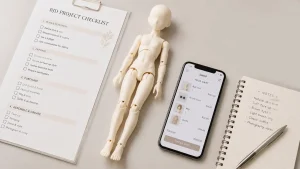
Blank vs Fullset BJD: What Each Option Actually Includes
Blank vs Fullset BJD: The Difference in One Minute
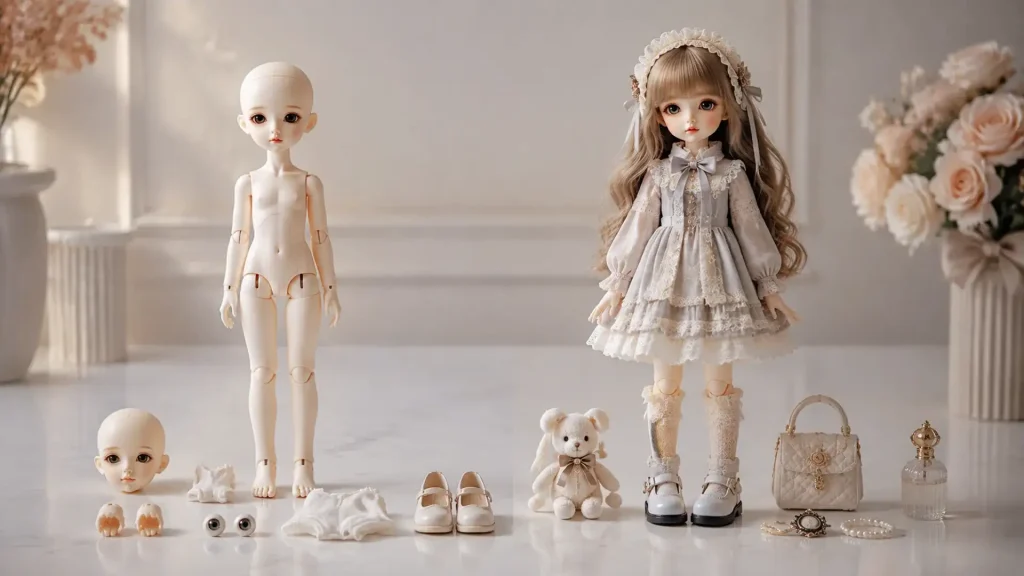
A blank BJD usually describes a doll sold without an applied face-up or a completed styling package. It may still include a head, body, assembly, stringing, default eyes, or other basic parts, depending on the maker’s configuration.
A fullset BJD usually describes a coordinated package built around a character, theme, or finished visual design. It may include a doll, face-up, eyes, wig, outfit, shoes, props, or edition-specific accessories, but there is no universal fullset contents list.
Short version: a blank configuration generally gives the buyer more styling decisions, while a fullset makes more of those decisions in advance. Neither option is automatically better, cheaper, or more suitable for beginners. The right choice depends on whether you want to customize the sculpt yourself or receive a coordinated interpretation from the maker.
If your priority is a lower initial checkout price and greater creative control, a blank configuration may be the better direction, although the exact price depends on the selected option. If you want a character look close to the promotional design with fewer separate sourcing decisions, a fullset may be more convenient.
Final rule: treat the product title as a clue, not a guarantee. The written inclusion list, selected product-page options, maker-specific definitions, and written seller confirmation should determine what you receive.
Blank vs Fullset BJD: Quick Comparison
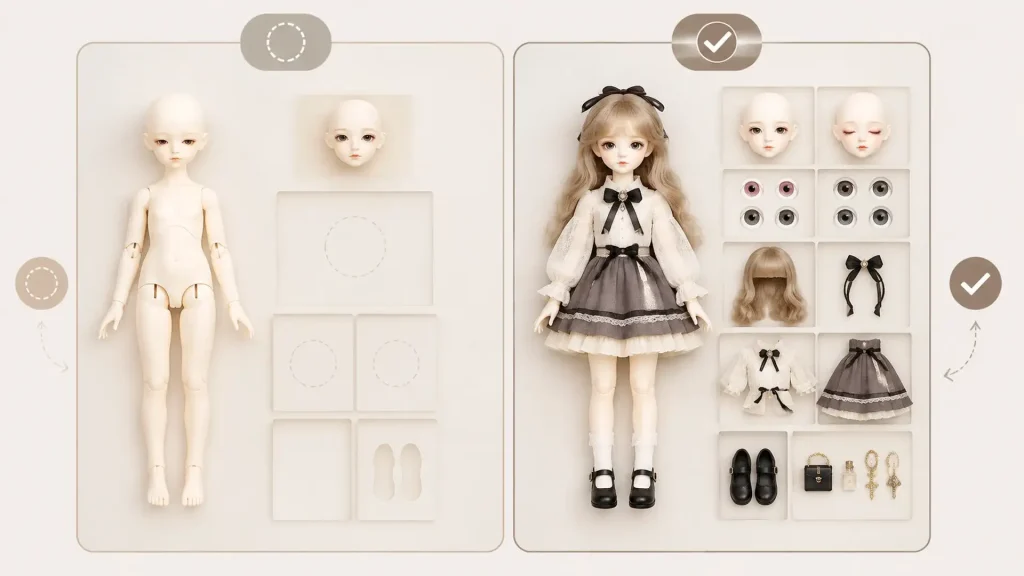
The table below describes common buying patterns, not universal industry definitions. Every row must be checked against the specific listing.
| Decision Factor | Blank BJD Configuration | Fullset BJD Configuration | What to Verify |
|---|---|---|---|
| Face-up | Often not applied; a face-up may be available as an add-on. | May include a standard maker face-up, named artist work, or another listed face-up service. | Whether face-up is included, optional, or unavailable. |
| Eyes | May be excluded, included as default eyes, or offered separately. | May be included, but material, size, color, and installation vary. | Whether eyes are included, installed, and compatible with the head. |
| Wig | Often not part of a blank package, but this is listing-dependent. | May include a themed or styled wig. | Wig circumference, style, material, and attachment method. |
| Outfit and shoes | Often purchased separately. | May be included in whole or in part. | Every visible garment, footwear item, and accessory. |
| Head and body | May be a complete doll, head only, body only, or kit. | May be a complete doll or a themed package with a specific structural option. | Whether the selected option includes head, body, hands, feet, and fantasy parts. |
| Assembly and stringing | May be assembled and strung, partly assembled, or unstrung. | May be assembled and strung, but this does not guarantee installed styling. | Physical assembly, elastic stringing, and whether the doll can stand independently. |
| Body blushing | Usually requires a separate service unless listed. | May or may not be included. | Do not infer body blushing from the word fullset. |
| Customization freedom | Often offers more freedom for DIY work or commissioned customization. | Usually centers on the maker’s coordinated design, although removable components can often be changed. | Which parts you want to keep, replace, or customize. |
| Initial price | May be lower for the selected blank configuration. | May be higher because of included styling, labor, exclusivity, or an edition premium. | Compare the selected package, not only the product title. |
| Final value | May become more expensive after separate services and accessories. | May offer efficient value if you want and use most included items. | Calculate the cost of reaching your intended character. |
What Is a Blank BJD?
On many product pages, blank BJD means that face-up paint has not been applied and that the doll is not being sold as a completed styling package. However, the word blank does not establish by itself whether the listing includes a head, body, default eyes, assembly, stringing, wig, clothing, or other parts.
A blank head-only listing and a blank complete-doll listing are different purchases. Both may be described as blank, but the physical contents and the amount of work required from the buyer can be completely different.
Related Terms Used with Blank BJDs
- Blank: Often points to an unpainted or minimally styled configuration, but the studio’s definition takes priority.
- Nude: Often means clothing is not included. It may still include face-up, default eyes, assembly, or other parts.
- Basic: May describe a minimally styled or standard version. Some brands use it for a doll with a face-up or default accessories, while others use it for a more stripped-down package.
- Default version: Usually refers to the maker’s standard option when no customization is selected, but the contents depend on the product page.
- Complete doll: Often means that the head and body are sold together. It does not necessarily mean the doll is painted, dressed, or fully styled.
- Blank head: A head sculpt sold without face-up, although eyes or a face-up service may be offered separately.
A blank configuration can suit a buyer who wants to paint the face-up personally, commission an independent artist, design an original character, or select a particular wig and eye combination. It can also suit a buyer who already owns compatible parts.
However, a blank doll does not automatically mean that every component is available for customization in the same order. Check whether the listing is for a head, body, complete doll, kit, or another configuration.
What Is a Fullset BJD?
A fullset BJD is usually a coordinated package intended to present a specific character, theme, or finished visual design. The term describes the package concept rather than a fixed universal checklist.
Depending on the release, the listed package may include the resin head and body, face-up, eyes, wig, outfit, shoes, props, extra parts, or edition-specific documentation. Any of these may be omitted, offered as a separate option, or shown only for styling reference.
A fullset can reduce the work of matching colors, proportions, and character details. It may still require unpacking, dressing, wig adjustment, eye installation, joint adjustment, or inspection after shipping. Assembled or strung describes the physical state of the doll, not whether it can stand independently or already has its eyes, wig, and clothing installed.
Body blushing, special face-ups, artist versions, certificates, and display accessories are release-specific. Do not treat any of them as standard fullset requirements without an inclusion list.
A factory or default face-up may refer to the maker’s standard option. An artist face-up may refer to a named artist’s interpretation or a separately commissioned service. These choices can differ in price, wait time, documentation, and whether the exact appearance can be recreated later.
Related Terms Buyers Commonly Confuse
The following terms overlap in casual conversation, but they should not be treated as universal synonyms.
| Term | What It Often Describes | What It Does Not Guarantee | What to Verify |
|---|---|---|---|
| Blank | An unpainted or minimally styled configuration. | It does not guarantee a complete head-and-body doll. | Head, body, face-up, eyes, wig, clothing, assembly, and stringing. |
| Nude | A doll without clothing. | It does not guarantee that the doll is blank. | Face-up, eyes, wig, body, and other styling items. |
| Basic or Default | A minimal or standard version defined by that seller. | It has no fixed meaning across brands. | The maker’s own package description. |
| Complete Doll | Often a head and body sold together. | It does not guarantee face-up, eyes, wig, clothing, or assembly. | Whether the term refers to structure only or to a finished package. |
| Assembled Doll | Parts connected or strung before shipping. | It does not guarantee independent standing or installed styling. | Assembly state, elastic stringing, and included styling. |
| Head Only | A resin head sculpt sold without a body. | It does not guarantee eyes, face-up, or neck compatibility. | Neck joint, face-up option, eyes, and recommended body. |
| Body Only | A resin body sold without a head. | It does not guarantee compatibility with a preferred head. | Neck size, resin color, joint system, and measurements. |
| Outfit Set | A clothing-focused package. | It does not guarantee that the doll is included. | Whether shoes, accessories, or the doll itself are included. |
| Fullset | A more complete, coordinated package. | It does not guarantee every item visible in promotional photos. | The written inclusion list and selected variant. |
| Limited or Artist Edition | A release with restricted availability or special authorship. | It does not guarantee that every edition has identical contents. | Edition details, order window, quantity, and package inventory. |
| Optional Add-On | An extra item or service selected separately. | It does not ship unless selected and paid for. | Whether the option was added correctly at checkout. |
| Reference Only | An item shown for presentation or styling context. | It does not guarantee inclusion. | Whether it appears in the written package manifest. |
For broader definitions of BJD terminology, see the BJD Glossary.
The Photo-to-Parcel Gap
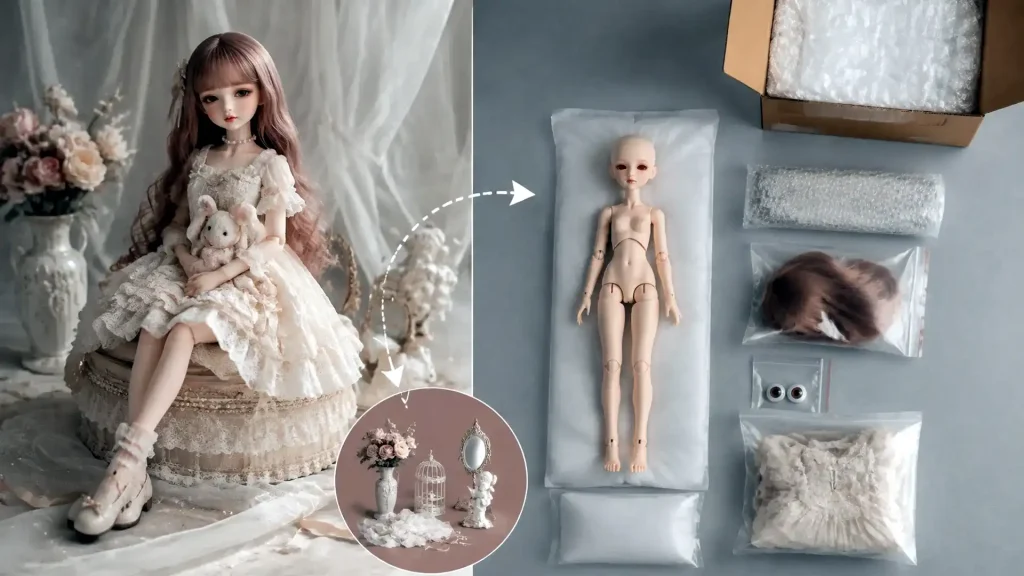
The Photo-to-Parcel Gap is the difference between the fully styled character shown in promotional images and the exact items included in the buyer’s selected package.
Promotional photos often communicate the character concept. They may show the complete visual direction of the release even when some items are optional, sold separately, used as props, or unavailable in the base configuration.
Promotional photos communicate the character concept; the written inclusion list defines the parcel.
A large Photo-to-Parcel Gap is not automatically evidence of misleading advertising. Styled photography is commonly used to present a character or artistic concept. The buyer’s responsibility is to identify the gap before payment and ask for clarification when the text and images do not align.
| Visible Item | Possible Package Status | What to Confirm |
|---|---|---|
| Face-up | Included, optional, standard, artist-applied, or reference-only | Whether it is included and which face-up option applies to the selected variant. |
| Eyes | Included, optional, installed, or shown for styling | Size, material, color, installation status, and whether they match the head. |
| Wig | Included, optional, separately sold, or photo-only | Size, style, color, material, and attachment method. |
| Clothing and shoes | Complete outfit, partial outfit, optional set, or styling reference | Every visible garment, footwear item, and accessory. |
| Jewelry and handheld accessories | Included, optional, edition-specific, or decorative | Whether each individual item is listed. |
| Props and furniture | Often photography props or separate products | Whether the stand, chair, book, cup, weapon, or other prop ships with the order. |
| Alternate hands or fantasy parts | Included in a special version, optional, or sold separately | Whether the selected edition includes every visible body part. |
| Backdrop and lighting | Usually photography setup only | Do not assume backgrounds or studio props are included. |
The Five-Layer Package Audit
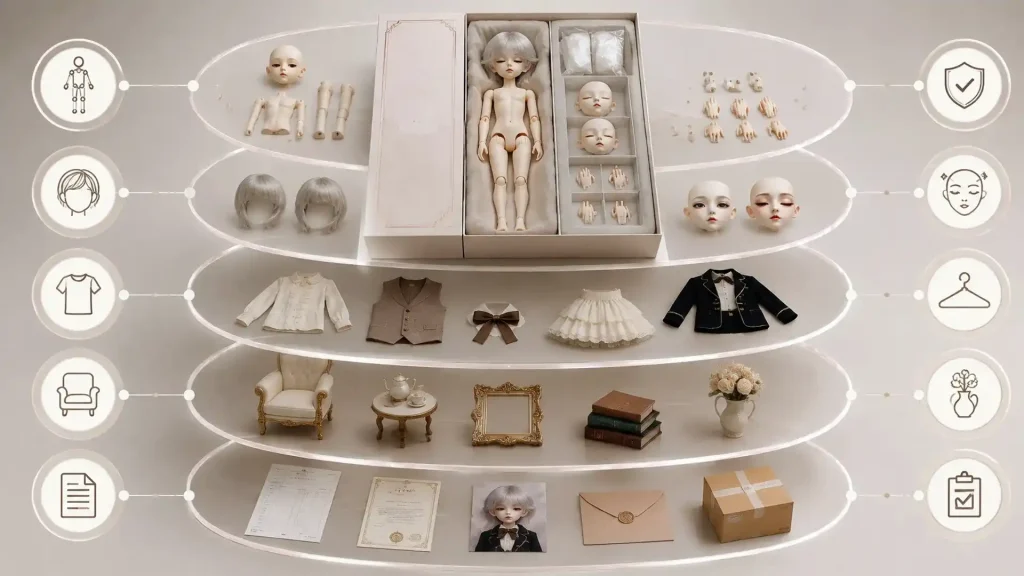
When a BJD listing is complicated, inspect it through five separate layers. Many ordering mistakes occur because buyers verify only the doll itself and overlook styling, display, or transaction details.
| Audit Layer | Items to Check | Typical Buyer Question |
|---|---|---|
| Layer 1: Physical Doll | Head, body, hands, feet, fantasy parts, assembly, elastic stringing | What physical doll parts are actually in the selected option? |
| Layer 2: Face and Head Styling | Face-up, eyes, eyelashes, wig, head-cap accessories | Will the head arrive blank, painted, or partially styled? |
| Layer 3: Wardrobe | Outfit, underwear, shoes, jewelry, weapons, handheld accessories | Which individual clothing and styling items are included? |
| Layer 4: Display | Stand, chair, background, furniture, photography props | Which visible display elements will actually be shipped? |
| Layer 5: Transaction | Selected option, body choice, skin tone, production time, shipping, taxes or import charges, cancellation and modification policy | What version did I select, and what financial or timing conditions apply? |
Before paying, ask three final questions:
- What is included automatically?
- What changes when I select a different option?
- Which visible items are not part of the order?
The BJD Configuration Readiness Ladder
Blank and fullset are not the only possible configurations. A listing may fall somewhere along a broader readiness ladder:
- Head Only: A head sculpt without a body.
- Body Only: A body intended to be paired with a head.
- Blank Complete Doll: Head and body sold together, usually without a completed face-up or styling package.
- Blank Doll with Face-Up Option: A blank base configuration with a selectable face-up service.
- Basic or Default Styled Version: A standard maker-defined configuration with selected default options.
- Fullset: A coordinated package with multiple listed styling elements.
- Limited or Artist Edition Package: A restricted release with edition-specific styling, parts, documentation, or packaging.
This ladder describes how much of the final presentation has already been selected or included. It is not a quality ranking. A blank doll is not an inferior version of a fullset, and a fullset is not automatically a higher-quality version of a blank doll.
How to Verify a BJD Package Before Ordering
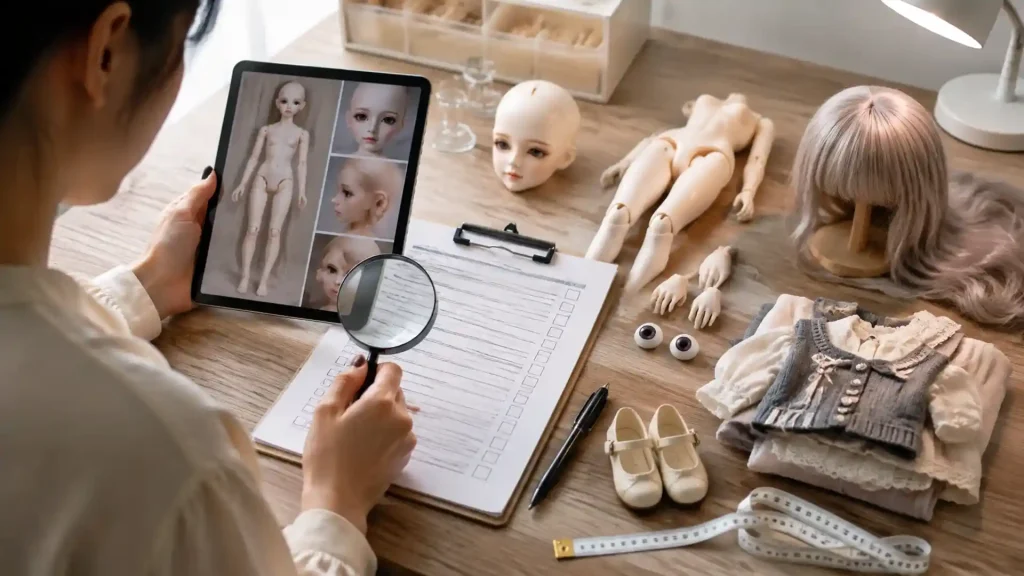
Use the following sequence instead of relying on promotional photos or general assumptions about common configurations:
- Identify the structural item: Check whether the option is head only, body only, complete doll, or a kit.
- Check the physical state: Confirm whether the doll is assembled and strung, partly assembled, or unstrung. Assembly does not guarantee independent standing.
- Check face-up options: Look for blank, factory face-up, artist face-up, or face-up add-on wording.
- Read the inclusion list: Confirm eyes, wig, outfit pieces, shoes, props, stand, certificate or documentation, and body blushing item by item.
- Check measurements and compatibility: Compare head circumference, eye size, wig size, shoe size, body type, skin tone, neck, and joint specifications before buying replacement parts.
- Match the selected variant: Verify size, color, edition, add-ons, body choice, and other checkout selections.
- Check the transaction terms: Separate production time from shipping time and read deposit, cancellation, modification, and refund policies.
- Request written clarification: If the text and photos conflict or a term is unclear, ask the seller to confirm the exact shipment contents before payment.
Blank vs Fullset: Comparing Total Cost
A blank may have a lower initial price, while a fullset may bundle several items. Neither option is automatically cheaper overall.
The useful comparison is not only:
Blank Price vs. Fullset Price
It is closer to:
Total Ownership Cost =
Base Configuration
+ Missing Components
+ Face-Up or Artist Commission
+ Eyes
+ Wig
+ Outfit
+ Shoes
+ Optional Body Blushing
+ Shipping and Optional Insurance
+ Taxes or Import Charges Where Applicable
+ Tools or Materials
+ Customization Costs
+ Display and Storage
+ Replacement or Fit-Related Costs
For a fullset, the same reasoning applies:
Fullset Ownership Cost =
Fullset Package Price
+ Shipping and Applicable Charges
+ Display and Storage
+ Replacement or Alternative Styling
+ Any Missing or Unused Components
Compare the cost of reaching your intended character, not only the price of entering the order.
“Cheaper” can mean three different things:
- Lower checkout price: The amount paid at the initial order.
- Lower finished-character cost: The amount required to reach the look you actually want.
- Lower time and effort cost: The amount of sourcing, commissioning, fitting, waiting, and coordination involved.
| Cost Category | Blank Path | Fullset Path |
|---|---|---|
| Initial price | May be lower for the selected blank configuration. | May be higher because of included styling, labor, exclusivity, or an edition premium. |
| Separate sourcing | May require additional purchases and coordination. | May reduce sourcing work when the included items match your needs. |
| Face-up work | May require DIY materials or an artist commission. | May already include a listed maker or artist face-up. |
| Shipping and fees | Multiple orders can create extra shipping, but not in every case. | A single package may simplify shipping, but its total charges still need to be calculated. |
| Time and effort | May include commissioning, sourcing, fitting, and styling. | May reduce coordination, but unpacking, dressing, eye installation, or adjustment may still be necessary. |
| Unused components | There may be fewer unwanted items. | You may pay for styling components you would not have chosen separately. |
A buyer who already owns compatible accessories may complete a blank doll efficiently. A buyer starting from zero may find that several separate purchases make the blank path more expensive. Conversely, a buyer who dislikes most of a fullset’s styling may pay for components that will immediately be replaced.
Reversible Styling vs. Maker-Specific Value
One useful way to compare blank and fullset options is to ask which parts are easy to replace and which parts are difficult to recreate.
| Component | Usually Easy to Replace? | Usually Maker-Specific? | Why It Matters |
|---|---|---|---|
| Wig | Often yes | Usually low | A different wig can change the character without permanently changing the doll. |
| Eyes | Often yes | Low to medium | Eye size, iris ratio, and gaze can usually be changed if compatible eyes are available. |
| Ordinary outfit | Often | Low to medium | Comparable clothing may be available, although exact fit and quality can vary. |
| Limited official outfit | Sometimes difficult | High | A discontinued or edition-specific outfit may be difficult to replace exactly. |
| Default face-up | Not exactly | Medium to high | A new face-up can be commissioned, but the original maker’s exact interpretation may not be reproducible. |
| Limited face-up | Usually difficult | High | The value may be connected to the original artist, edition, or release history. |
| Fantasy parts | Sometimes difficult | Medium to high | Special horns, wings, tails, hands, or other parts may be edition-specific. |
| Skin tone | Often difficult | High | Matching a discontinued resin tone across different makers or production batches can be challenging. |
| COA and original packaging | No styling replacement | High for provenance | Documentation and packaging may matter to collectors even though they do not change the doll’s appearance. |
This distinction does not mean that fullsets always have greater value or that blank dolls are better for customization. It means the buyer should identify which parts of the official character are essential.
A blank buyer may value open-ended customization. A fullset collector may value the integrity of the original package. Neither approach is inherently superior.
Which Option Is Better for Different Buyers?
| Buyer Situation | Blank May Fit If… | Fullset May Fit If… | Main Question to Ask |
|---|---|---|---|
| First-time buyer | You already have a clear customization plan. | You want fewer separate sourcing decisions. | Do I want to learn customization immediately? |
| Experienced customizer | You want to control the face-up and styling. | You value a particular official interpretation or limited outfit. | Which parts would I keep if I bought the fullset? |
| Face-up artist | You want an unpainted canvas. | You want the official face-up as a reference or collectible feature. | Would I replace the included face-up? |
| Original-character creator | You want to create an individual character from the sculpt. | The official character already matches your concept. | Do I want the sculpt or the maker’s character? |
| Photographer | You want flexible themes and multiple looks. | You want a coordinated visual concept quickly. | Will the included styling support my planned photos? |
| Edition-focused collector | You are intentionally building a different interpretation. | You want the original package and edition-specific components. | Which original components would be difficult to replace later? |
| Buyer with an existing wardrobe | You already own compatible wigs, eyes, clothing, and shoes. | The fullset contains rare or important pieces. | Will I use the included items? |
| Buyer with limited access to custom services | You are comfortable with gradual DIY work. | You want a maker-finished option without finding several artists. | How difficult will it be to source missing services? |
| Budget-conscious buyer | You can source parts affordably or already own them. | The fullset replaces several separate purchases you would otherwise make. | What will the finished character actually cost? |
| Buyer who dislikes the official styling | You want to avoid paying for styling you will replace. | A rare component of the fullset is still essential to you. | Can I buy only the components I actually want? |
| Buyer who loves the promotional character | You want to reinterpret the character yourself. | You want the coordinated maker presentation. | Does the selected package actually include the photographed look? |
Practical Buying Scenarios
- New collector buying a finished character: A fullset may be simpler if the inclusion list covers the desired doll and styling.
- Buyer commissioning an independent face-up artist: A blank configuration may avoid paying for a face-up that will be replaced, provided the required head and body are included.
- DIY full customization: A blank configuration usually offers a cleaner starting point, but the buyer must budget for compatible parts and services.
- Secondhand fullset buyer: A fullset can be worthwhile if the inventory is complete and the condition, modifications, and price are acceptable.
- Collector seeking a limited outfit: A fullset may be more attractive if the outfit or fantasy parts would be difficult to source separately.
Common Blank vs Fullset Buying Mistakes
Most configuration mistakes come from treating a general label as a complete package description.
- Assuming everything in the photos is included.
Promotional images may contain props, alternate styling, or optional items. Read the written inclusion list. - Assuming blank means a complete nude doll.
A blank listing may be head only, body only, complete doll, or another configuration. Confirm the structural item. - Assuming fullset means absolutely everything.
Fullset has no universal contents standard. Check every visible item individually. - Assuming assembled means fully styled.
Assembly refers to the physical doll structure, not necessarily face-up, eyes, wig, clothing, or shoes. - Assuming complete doll means fullset.
Complete doll often refers to head and body being sold together. It may still arrive blank or nude. - Comparing only the initial prices.
A blank may require face-up work, accessories, and several separate purchases. Compare the finished-character cost. - Ignoring face-up commission time.
A blank configuration may require an artist booking, shipping, and a separate waiting period. - Not checking whether eyes are included.
Eyes may be optional, random, installed, or sold separately. Verify size, material, color, and installation status. - Not checking shoes separately.
Clothing compatibility does not guarantee shoe compatibility. Compare foot length and width. - Ignoring body choice.
Different body options can change proportions, clothing fit, pose style, and visual balance. - Ignoring resin color or skin tone.
A head and body from different makers or batches may not match as expected. - Assuming a limited fullset can be completed later.
Discontinued outfits, face-ups, fantasy parts, and documentation may be difficult to source. - Assuming a default face-up can be reproduced exactly.
A new artist may create a similar mood but not an identical result. - Forgetting that props may be photography-only.
Furniture, books, cups, stands, and backgrounds require separate confirmation. - Treating production time as shipping time.
Courier speed begins after production and dispatch, not at checkout. - Failing to save the final listing.
For preorder or limited purchases, save screenshots or written details of the selected configuration and inclusion list.
Secondhand Blank and Fullset Configuration Checks
A secondhand “fullset” may no longer be complete. The original release name describes what the package may have contained when first sold, not necessarily what the current seller still owns.
Ask for an exact inventory rather than relying on the original release title. Confirm whether the original face-up, eyes, wig, clothing pieces, shoes, certificate, stand, and accessories are present. Ask whether any item has been replaced, modified, stained, damaged, or sold separately.
| Secondhand Item | What to Check |
|---|---|
| Head and body | Whether both original parts are present, and whether either has been swapped. |
| Face-up | Whether it is original, replaced, damaged, sealed, or modified. |
| Eyes | Whether they are the original pair, compatible replacements, or missing. |
| Wig | Whether it is the original wig, a replacement, or absent. |
| Outfit and shoes | Whether the complete outfit is present, including small accessories and footwear. |
| Fantasy parts | Whether horns, wings, tails, extra hands, weapons, or other edition-specific parts are included. |
| Documentation | Whether COA, receipts, original packaging, and maker documents are available where relevant. |
| Condition | Whether there is yellowing, staining, chips, cracks, looseness, face-up wear, or odor from storage. |
| Provenance | Whether the seller can explain the ownership history and provide current photographs. |
Compare current photos with the written inventory and inspect the resin condition in suitable light. Resin appearance and condition can vary with age, use, storage, and prior care, so do not treat a seller’s configuration label as proof of completeness.
Buyer Decision Worksheet
Before choosing blank or fullset, answer these questions:
- Do I want this sculpt, or do I want this exact styled character?
- Do I already own compatible eyes, wigs, clothes, and shoes?
- Do I want to create or commission the face-up?
- Am I comfortable sourcing accessories separately?
- Which promotional elements are essential to me?
- Am I buying primarily to customize, display, photograph, or preserve an edition?
- What is my realistic completion budget?
- How much waiting and coordination am I willing to accept?
- Would I replace most of the styling included in the fullset?
- Which components would be difficult to recreate if I bought blank?
If you mainly want the sculpt as a creative foundation, blank may fit your intent. If you mainly want the maker’s complete visual interpretation, fullset may fit your intent. If you want only selected parts of the official look, compare the cost of buying those parts separately with the fullset price.
Final Pre-Purchase Verification Checklist
Before completing checkout, confirm:
- What exactly am I buying: head, body, complete doll, kit, blank, basic, or fullset?
- Is the doll assembled and strung, partly assembled, or unstrung?
- Is face-up included, optional, standard, artist-applied, or unavailable?
- Are eyes included, and are they installed?
- Are the wig, outfit, shoes, and accessories included?
- Are props, stands, furniture, and background items included?
- Is body blushing included?
- Are extra hands, fantasy parts, or alternate components included?
- Which body and skin tone did I select?
- Do the actual measurements support my planned clothing, wig, and shoe purchases?
- What is the production lead time?
- What is the shipping or transit time?
- Will taxes, customs, or other charges apply in my location?
- What are the deposit, payment, cancellation, modification, and refund policies?
- Who is the seller or maker?
- If this is secondhand, what is the provenance and current inventory?
- Have I saved the final product description and selected options?
For a broader beginner purchasing framework, see the First BJD Buying Checklist.
Blank vs Fullset BJD FAQ
What is the difference between a blank and fullset BJD?
A blank BJD usually offers an unpainted or minimally styled starting configuration, while a fullset usually offers a more coordinated package built around a specific character or design. Neither term has a universal contents list. The product page determines whether the head, body, face-up, eyes, wig, clothing, shoes, and other items are included.
What does a blank BJD include?
A blank BJD may include a complete head-and-body doll, a head only, a body only, or another configuration. It often excludes an applied face-up and completed styling, but eyes, assembly, stringing, or basic accessories may vary. Read the individual listing instead of assuming that every blank package contains the same parts.
What does a fullset BJD include?
A fullset may include the doll, face-up, eyes, wig, outfit, shoes, props, extra parts, or edition-specific documentation. The exact contents depend on the maker and release. A fullset is a package category, not a universal inventory standard, so confirm each item in the written inclusion list.
Does a fullset include everything shown in the photos?
Not necessarily. Promotional photos may include props, furniture, stands, alternate outfits, decorative items, or optional styling pieces. Styled images communicate the character concept, while the written inclusion list defines the parcel. If a visible item is not listed, ask the seller before payment.
Does a blank BJD come with eyes?
Not automatically. Some blank configurations include default eyes, while others exclude eyes or offer them as a separate option. Confirm whether eyes are included, their material and size, their color, and whether they are installed before ordering.
Does a blank BJD come assembled?
Sometimes. A blank doll may arrive assembled and strung, partly assembled, or unstrung, depending on the maker and option selected. “Blank” describes the styling state, not necessarily the physical assembly state. Check whether the head and body are connected and whether elastic stringing is included.
Does fullset always include a face-up?
No. Many fullsets include a face-up, but this is not a universal requirement. The face-up may be a maker default, a named artist’s work, an optional service, or excluded from a particular configuration. Confirm the face-up status for the selected variant.
Is body blushing included in a fullset?
Not always. Body blushing may be included, optional, unavailable, or limited to selected body parts. Do not infer body blushing from the word fullset or from promotional photos. Check the package description and the selected add-ons.
Is a blank BJD cheaper than a fullset?
A blank BJD may have a lower initial checkout price, but it is not automatically cheaper after adding a face-up, eyes, wig, clothing, shoes, commissions, shipping, and display supplies. A fullset may be better value when you want most of its included items. Compare the total cost of reaching your intended character.
Is a fullset BJD better for beginners?
A fullset may be easier for a beginner who wants a coordinated character and fewer separate purchasing decisions. A blank may be better for a beginner with a clear DIY plan, an existing wardrobe, or a preferred face-up artist. The best choice depends on the buyer’s goals, budget, and willingness to customize.
Can I change the wig and eyes on a fullset BJD?
Usually, wigs and eyes are removable and can be changed if the replacement items fit the doll. Check head circumference, eye diameter, iris size, socket depth, and the condition of the original parts. If the fullset has edition-specific styling, store the original components carefully if preserving the package matters to you.
What does “complete doll” mean?
“Complete doll” often means that the head and body are sold together, especially when contrasted with head-only or body-only options. It does not automatically mean fullset, fully painted, dressed, or ready to display. Read the seller’s definition and check face-up, eyes, wig, clothing, and assembly separately.
Is an assembled doll the same as a fullset?
No. An assembled doll has its physical parts connected or strung, while a fullset describes a package that may contain coordinated styling and accessories. An assembled doll can still be blank, nude, or missing a wig, eyes, outfit, and shoes.
Can I buy a blank BJD and add a factory face-up?
Sometimes. Some makers offer a face-up as an option during the original order, while others sell blank dolls only or require a separate artist commission. Check whether the face-up option is available for the selected sculpt, body, skin tone, and order period.
How do I verify a secondhand fullset?
Ask for a complete current inventory, including head, body, original face-up, eyes, wig, outfit, shoes, fantasy parts, packaging, documentation, and accessories. Ask which items were replaced or modified, request current photos, and compare the seller’s inventory with the original release description.
What should I check before ordering a BJD?
Verify the exact structural item, configuration, face-up status, included eyes, wig, outfit, shoes, body choice, skin tone, measurements, production time, shipping time, payment terms, cancellation policy, and seller information. If the photos and written description conflict, request written clarification before payment.
Conclusion: Choose the Package That Matches Your Intent
Blank vs fullset BJD is fundamentally a choice between a more open starting configuration and a coordinated package. A fullset may be the better option when you want less sourcing and a character look with minimal planning. A blank may be the better option when you want a lower initial commitment, a specific customization route, or control over every component.
Neither option is automatically better value. A blank may become more expensive after commissions and compatible accessories. A fullset may include items you do not want to use. Limited face-ups, official outfits, fantasy parts, skin tones, and documentation may also be harder to replace than ordinary wigs, eyes, or clothing.
Use one decision rule for every purchase: ignore assumptions based only on the words blank, nude, basic, complete, assembled, or fullset. Verify the specific product page’s written inclusion list, selected options, exact measurements, production details, and seller confirmation.
For broader terminology, see the BJD Glossary. For beginner purchasing guidance, visit the BJD Library.