BJD Size Chart: 1/6, 1/4, 1/3, MSD, SD & 70cm Doll Scale Guide
If you are new to ball-jointed dolls, BJD size labels can feel confusing at first. Collectors use scale terms like 1/4 and 1/3, height labels like 60cm or 70cm, and older community terms like MSD, SD, and YoSD. These labels are useful, but they are not universal standards.
The most important rule is simple: use a BJD size chart as a starting point, then check the actual measurements of the doll before buying clothing, wigs, eyes, shoes, stands, or display furniture.
A 1/4 BJD from one maker may be 41cm tall with childlike proportions, while another 1/4 BJD may be 45cm tall with a slim mature body. They may both be called 1/4, but they may not wear the same clothes or shoes.
If you are still learning basic BJD terms such as blank doll, fullset, face-up, resin, wig size, and eye size, you can start with the BJD Library first, then return to this chart when you are ready to compare sizes.
Quick Answer: What Is the Best BJD Size for Beginners?
There is no single best BJD size for every beginner. Many beginners find 1/4 scale BJDs practical because they are large enough for styling and photography, but easier to handle and store than many 1/3 or 70cm dolls.
Here is the short version:
- 1/6 BJD: easier to store, easier to carry, good for small spaces.
- 1/4 BJD: often the most balanced beginner size for handling, display, and styling.
- 1/3 BJD: stronger visual presence, better for dramatic styling and photography.
- 70cm BJD and larger: impressive, but heavier and more demanding in space, stands, clothing, and handling.
If you are unsure, choose based on your real situation: shelf space, budget, handling comfort, clothing plans, and the kind of character you want to create.
Main BJD Size Chart
This BJD Size Chart gives a practical overview of common size ranges. The numbers are approximate. Always check the specific product measurements before buying accessories.
| Common Size Name | Approx. Scale | Approx. Height | Common Labels | Best For | Beginner Notes |
|---|---|---|---|---|---|
| Tiny / YoSD-like | ~1/6 or smaller | 20-30 cm | Tiny, YoSD, Yo, Petite | Small displays, cute styling, easy carrying | Very compact, but tiny clothes, eyes, and shoes can be harder to handle. |
| 1/6 BJD | 1/6 | 26-32 cm | 1/6, Tiny, Small BJD | Travel, desk display, small-space collectors | Easy to store and carry, but has less room for detailed face-up and clothing work. |
| 1/4 BJD / MSD-like | ~1/4 | 40-45 cm | MSD, Mini, Mature Mini, 1/4 | First BJD, balanced display, general styling | A practical middle size, but check whether the body is childlike, slim, or mature. |
| 1/3 BJD / SD-like | ~1/3 | 55-65 cm | SD, 1/3, 60cm | Photography, fashion styling, strong shelf presence | More impressive visually, but heavier and needs more display space. |
| 60cm BJD | ~1/3 | 58-62 cm | 60cm, SD-like | Classic large BJD display and styling | Good for detailed outfits and portraits, but needs stronger handling habits. |
| 65cm BJD | ~1/3 tall | 62-67 cm | 65cm, tall SD-like | Taller characters, mature styling, fashion looks | Check sleeve length, inseam, shoulder width, and foot size carefully. |
| 70cm BJD and Larger | ~1/3 extra tall | 68-75+ cm | 70cm, 72cm, 75cm, large BJD | Dramatic display, large male sculpts, fantasy characters | Beautiful but heavy. Plan for deep shelves, sturdy stands, larger clothes, and shipping space. |
Important note: exact height and body measurements vary by maker, sculpt, body type, head size, and proportion. Size labels help you compare dolls, but real measurements decide fit.
The Core Idea: Size Labels Are Not Fit Guarantees
A BJD size label tells you the general category. It does not guarantee that clothes, wigs, eyes, or shoes will fit.
Think of BJD size in two layers:
- Scale label: 1/6, 1/4, 1/3, MSD, SD, 70cm.
- Fit measurements: height, head circumference, bust or chest, waist, hips, shoulder width, arm length, inseam, foot length, and foot width.
For buying decisions, the second layer is more important. A simple way to think about it is:
Scale helps you search. Measurements help you avoid mistakes.
This is one of the biggest differences between casual doll buying and BJD collecting. In BJD, the same scale can contain very different body shapes.
What Do 1/6, 1/4, and 1/3 Mean in BJD Sizes?
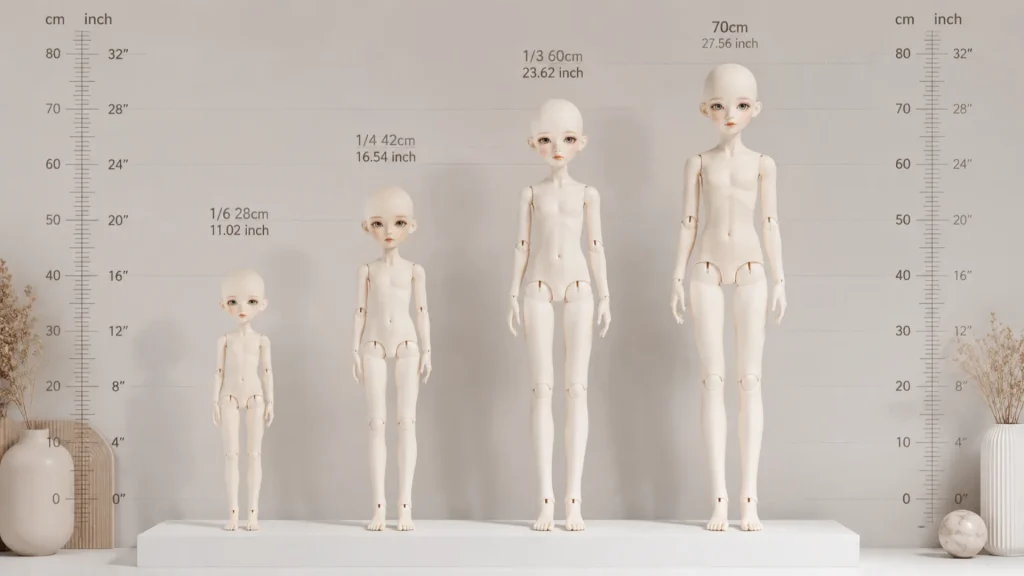
Scale labels are a rough way to describe the doll’s size compared with a human body. If we use an average adult height of about 170cm as a loose reference, the math looks like this:
- 1/6 scale: about 28cm
- 1/4 scale: about 42cm
- 1/3 scale: about 57cm
Real BJDs do not always follow this math exactly. Artists and studios create dolls with different ages, fantasy body shapes, anime proportions, mature bodies, childlike bodies, and stylized heads. That is why a 43cm doll and a 45cm doll may both be called 1/4 scale.
Proportion matters as much as height. For example:
- Childlike bodies often have larger heads, softer torsos, shorter limbs, and straighter waists.
- Mature mini bodies often have smaller heads, narrower waists, longer limbs, and more adult fashion proportions.
- Anime-style bodies may have larger eyes, larger heads, slimmer limbs, or more stylized silhouettes.
Two dolls can be the same height but need different clothes because their body shapes are different.
Common BJD Size Terms Explained
- Tiny
- A loose term for small BJDs. Depending on context, it may describe very small dolls or dolls around the 1/6 range.
- YoSD
- A term often used for childlike dolls around 26cm. Many collectors use it as a general reference for small child-proportioned BJDs.
- 1/6 BJD
- A small BJD size range, often around 26-32cm. Good for compact displays and carrying, but accessories can be small and delicate.
- MSD
- A common shorthand for 40-45cm mini BJDs. It is useful, but not universal. MSD-like dolls can have childlike, slim, or mature proportions.
- 1/4 BJD
- A popular middle size range, often around 40-45cm. Many beginners like this size because it balances handling, display space, and styling options.
- Mature Mini
- A 1/4 scale doll with more adult proportions, such as a narrower waist, longer legs, and a more fashion-like body shape.
- SD
- A common shorthand for larger BJDs, often in the 55-65cm range. Like MSD, it is a useful category label but not a universal fit standard.
- 1/3 BJD
- A large BJD size range, usually around 55-65cm. It offers strong visual presence and more room for detailed styling. Browse verified models in our 1/3 BJD dolls collection.
- 70cm BJD
- A large and tall BJD range, usually around 68-75cm or more. These dolls are dramatic but need more space, stronger stands, and careful handling.
- Blank Doll
- A doll sold without styling options such as face-up, wig, eyes, outfit, or shoes, unless the listing clearly says otherwise.
- Fullset
- A package that may include styling options such as face-up, wig, eyes, outfit, shoes, or accessories. The exact included items depend on the selected option and product description.
For more beginner terms, see the BJD Glossary.
BJD Size by Use Case
The best size depends on what you want to do with the doll. A doll that is perfect for photography may not be perfect for travel. A doll that looks amazing on a large shelf may feel too heavy for a beginner.
| Use Case | Suggested Size Range | Why It May Work | Watch Out For |
|---|---|---|---|
| First BJD | 1/4 or 1/3 | 1/4 is balanced and easier to handle; 1/3 gives stronger visual impact. | Choose based on your space, strength, and styling goals, not only photos. |
| Small-Space Display | 1/6 or compact 1/4 | Smaller dolls fit more easily on desks, shelves, and small display areas. | Small accessories may be harder to find and handle. |
| Travel or Carrying | 1/6 to 1/4 | Lighter and easier to pack in padded bags. | Use a face protector and avoid loose accessories during transport. |
| Doll Photography | 1/4 to 1/3 | Good balance of presence, posing, and styling detail. | Larger dolls are harder to carry outdoors and may need stronger stands. |
| Face-up Practice | Practice heads, 1/4, or 1/3 | Larger heads give more room to paint brows, lashes, blush, and lips. | Practice heads are safer for learning than expensive finished dolls. |
| Wig Styling | 1/4 to 1/3 | Wigs are large enough to style and photograph clearly. | Always measure head circumference before buying. |
| Clothing Customization | 1/3 or larger 1/4 | More fabric area makes sewing and fitting easier. | Patterns still need adjustment for body shape and proportions. |
| Character Display | 1/3 or 70cm | Large dolls create stronger presence for original characters and fantasy looks. | Need deep shelves, sturdy stands, and more storage space. |
| Kawaii Styling | 1/6, 1/4, or 1/3 | Cute styling depends on face sculpt, eyes, wig, and outfit, not only size. | Do not assume kawaii always means small. |
| Anime-Inspired Styling | 1/4, 1/3, or 70cm | Anime-style looks can work across many sizes with the right eyes, wig, and face-up. | Large anime heads may need larger wigs or different eye sizes. |
A Practical Fit System: Check the Three Zones
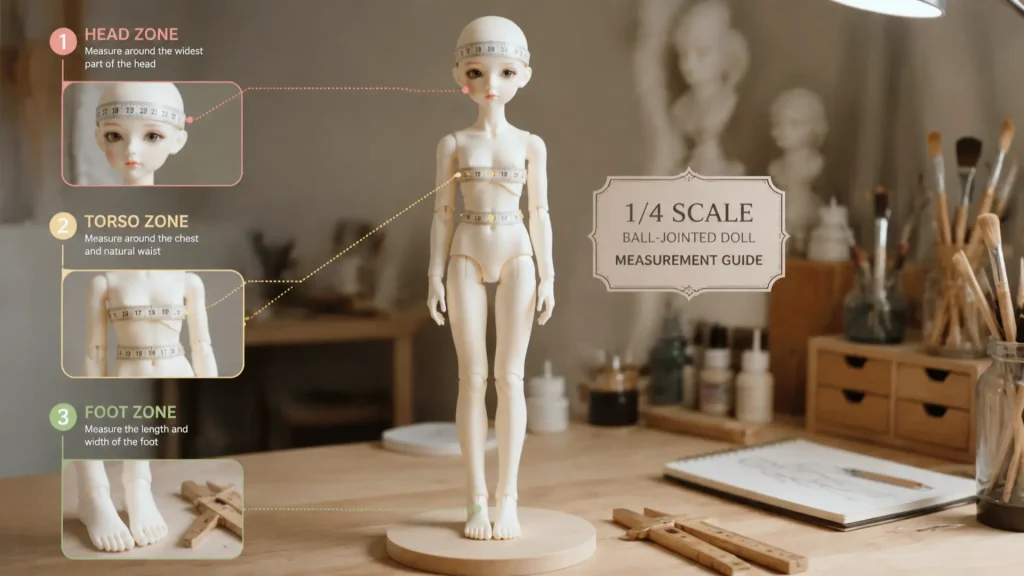
Here is a simple method that many beginners can use before buying clothes or accessories. Instead of asking, “Is this 1/4 size?” ask whether the item fits the doll’s three fit zones.
- Head Zone: head circumference, wig size, eye size, eye socket depth, and face-up protection.
- Torso Zone: shoulder width, bust or chest, waist, hips, neck size, and sleeve length.
- Foot Zone: foot length, foot width, ankle shape, heel height, and whether the feet are removable.
This three-zone check is often more useful than scale labels alone. A doll may be 1/4 scale, but if the head is large, the body is slim, and the feet are wide, it may need a mix of accessory sizes.
How BJD Size Affects Handling, Storage, and Display
Studio photos often make every doll look easy to handle. In real life, size changes the way you live with the doll.
Weight and Handling
Resin BJDs are usually heavier than many vinyl or plastic dolls. Weight depends on resin density, wall thickness, body size, and joint construction, but these rough ranges can help you plan:
- 1/6 BJD: often around 200-400g. Easy to hold and carry.
- 1/4 BJD: often around 600-900g. Manageable for many beginners.
- 1/3 BJD: often around 1.2-2.0kg. Better handled with two hands.
- 70cm+ BJD: often around 2.0-3.5kg or more. Needs careful support when posing.
These are only general estimates. Always check the actual product information if weight matters to you.
Display Footprint
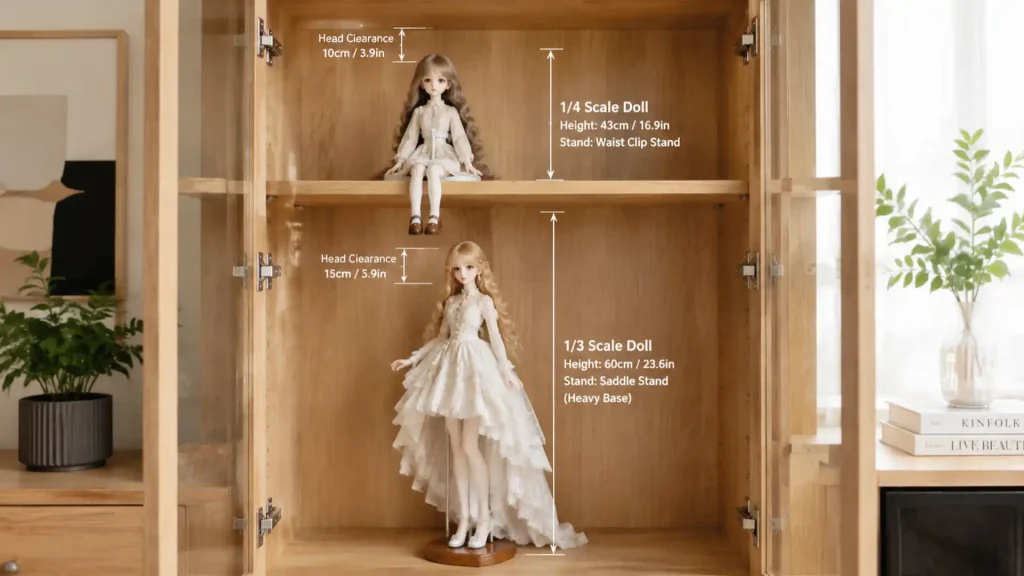
A doll’s standing height is not the only space requirement. You also need to consider the display envelope: the real space around the doll after adding wig height, shoes, stand base, pose, and outfit volume.
For example, a 60cm doll may need about 70cm of vertical clearance when standing on a base with a styled wig. A 70cm doll may need 80-85cm or more, especially with tall hair, hats, fantasy horns, or large shoes.
Doll Stands
Large BJDs should not rely only on friction posing for long-term standing display. A proper stand can reduce the risk of falls.
- Saddle stands: support the doll under the pelvis and are often useful for dresses and skirts.
- Waist-clip stands: hold the torso and can work well for pants, suits, and upright display poses.
- Heavy bases: are helpful for 1/3 and 70cm dolls, especially on shelves or display tables.
BJD Clothing Size Compatibility
Clothing compatibility is one of the biggest sizing traps in BJD collecting. A tag that says “MSD size” or “1/3 SD size” does not mean the outfit will fit every doll in that category.
Before buying clothes, check these measurements:
- Shoulder width
- Bust or chest circumference
- Waist circumference
- Hip circumference
- Arm length
- Leg length
- Inseam
- Neck size
- Foot length and width for shoes
Common fit problems include:
- Mature mini vs. childlike MSD: slim mature mini clothing may not fit a wider childlike body.
- 60cm vs. 70cm: sleeves and pants made for 60cm dolls may be too short for 70cm bodies.
- Wide feet vs. slim shoes: shoes can fail even when the doll’s scale looks correct.
- Stretch fabric vs. non-stretch fabric: a small measurement difference matters more with stiff fabrics.
A useful buying habit is to compare the garment’s finished measurements with your doll’s body measurements. If the clothing is tight, allow extra room for seams, fabric thickness, and posing.
If you need more detail later, use the planned BJD Clothing Size Guide.
BJD Wig Size and Eye Size Considerations
How BJD Wigs Are Sized
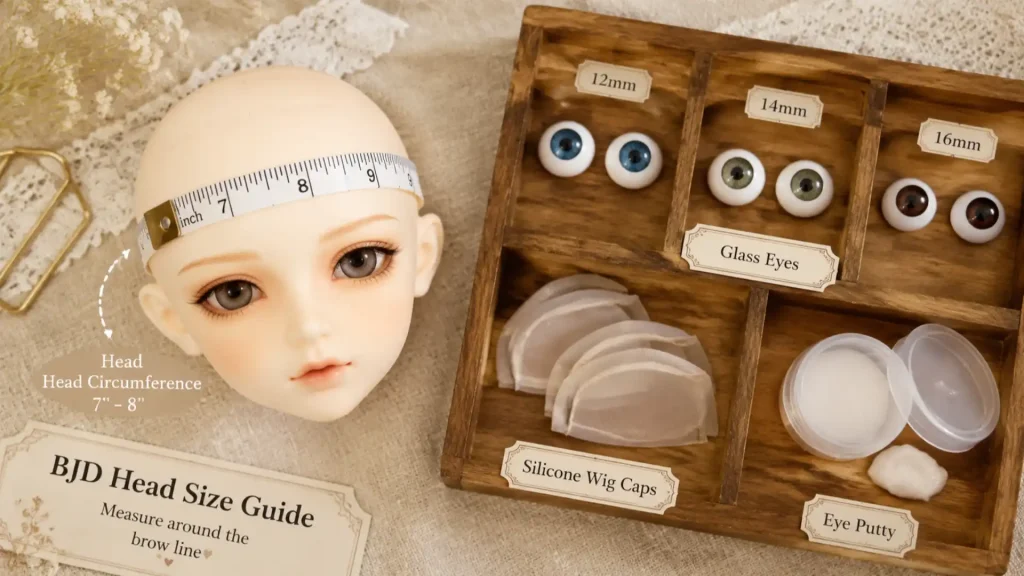
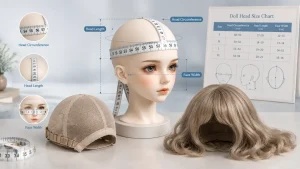
BJD wigs are usually sized by head circumference in inches. To measure, wrap a flexible tape measure around the widest part of the doll’s head, usually above the brow and around the back of the head. If your measurement is in centimeters, divide by 2.54 to convert it to inches.
- 5-6 inches: micro tinies and some small 1/6 dolls
- 6-7 inches: many 1/6 dolls and some small-headed 1/4 dolls
- 7-8 inches: many standard 1/4 dolls and some small-headed 1/3 dolls
- 8-9 inches: many 1/3 dolls and some 70cm dolls
- 9-10 inches: large-headed 1/3 dolls and some anime-style heads
A slightly loose wig can often be improved with a silicone wig cap. A wig that is too small may rub the face-up, pull at the head cap, or sit unnaturally high.
How BJD Eyes Are Sized
BJD eyes are usually sold by total eye diameter in millimeters, such as 12mm, 14mm, or 16mm. The correct eye size depends on the sculpt, the eye opening, the socket depth, and the look you want.
- Total diameter: decides whether the eye can sit inside the socket.
- Iris size: changes the expression. A larger iris can look more anime or youthful; a smaller iris can look more mature or realistic.
- Dome height: affects whether the eye fits shallow or deep sockets.
- Eye putty position: can slightly change the gaze direction and expression.
Do not choose eyes by doll scale alone. Two 1/4 dolls may need different eye sizes if their head sculpts are different.
For more detailed accessory planning, see the planned BJD Wig and Eye Size Guide.
Blank vs Fullset Size Considerations
Size also affects what you may need to buy after the doll itself.
A blank BJD usually means the resin doll is sold without styling options such as face-up, wig, eyes, outfit, shoes, or accessories, unless the listing clearly says otherwise.
A fullset BJD may include some styling parts, such as face-up, wig, eyes, outfit, shoes, or accessories. However, fullset contents vary by product and option. Always check what is included before ordering.
Scale matters because larger dolls often need larger and more expensive accessories. A 1/3 or 70cm doll may require larger wigs, more fabric, bigger shoes, stronger stands, and larger storage boxes. A smaller doll may save space, but tiny accessories can be harder to handle or replace.
If you are unsure about included items, read Blank vs Fullset BJD and the First BJD Buying Checklist before placing an order.
Anime BJD and Kawaii BJD Size Notes
Anime-style and kawaii BJD dolls can exist in many sizes. Cute styling is not limited to tiny dolls, and anime-inspired styling is not limited to 1/4 scale.
The final look depends on several factors:
- Face sculpt
- Eye size and iris style
- Face-up color and line work
- Wig color, volume, and cut
- Outfit shape
- Body proportions
- Photography angle and lighting
A 1/6 doll can look soft and portable. A 1/4 doll can feel balanced and expressive. A 1/3 or 70cm doll can create a strong character presence, especially with detailed clothing and dramatic wigs.
If you are exploring style direction, browse Anime BJD Dolls or Kawaii BJD Dolls after you understand the size differences.
Common Mistakes When Choosing BJD Size
- Buying based only on product photos: Photos can hide scale. Always check the actual height and measurements.
- Assuming all 1/4 dolls fit the same clothes: Mature mini, slim mini, and childlike bodies can need different clothing sizes.
- Treating MSD and SD as universal standards: These are useful community terms, not guaranteed fit labels.
- Choosing wigs by doll height: Wig size depends on head circumference, not height alone.
- Choosing eyes only by scale: Eye size depends on sculpt, eye opening, socket depth, and desired expression.
- Forgetting foot width: Shoes depend on both foot length and width. Some resin feet are wider or flatter than expected.
- Ignoring display space: A 70cm doll needs more than 70cm of real display clearance after adding wig, stand, and pose.
- Underestimating weight: Larger resin dolls need careful two-handed handling and sturdy shelves.
- Assuming fullset means everything in the photos: Fullset contents depend on the selected option and product description.
- Starting with a very unusual scale: Ultra-niche sizes can be beautiful, but they may have fewer ready-made clothes and accessories.
BJD Size Checklist Before Buying
Before buying a doll, outfit, wig, eyes, shoes, or display stand, check these details:
- Doll height
- Head circumference
- Recommended eye size
- Shoulder width
- Bust or chest circumference
- Waist circumference
- Hip circumference
- Arm length
- Leg length
- Inseam
- Foot length
- Foot width
- Skin tone
- Body type: childlike, mature, slim, muscular, or stylized
- Included items
- Face-up option
- Wig option
- Eye option
- Outfit option
- Shoe option
- Processing time
- Shipping information
A good rule is to save the doll’s measurement chart before buying accessories. Treat it like a passport for the doll. Whenever you buy clothes, wigs, shoes, or a stand, compare the item to that chart first.
BJD Size Chart FAQ
What is the most common BJD size?
Many collectors commonly encounter 1/4 and 1/3 BJDs because these sizes offer a practical balance of display presence, customization space, and accessory availability. However, the most suitable size depends on your space, budget, and styling goals.
What size BJD is best for beginners?
There is no single best size for every beginner. Many beginners like 1/4 scale because it is large enough for styling and photography but easier to store and handle than many 1/3 or 70cm dolls.
Is 1/4 BJD good for beginners?
Yes, 1/4 BJD dolls are often beginner-friendly. They usually offer a practical mix of size, weight, clothing options, and display flexibility. You still need to check the exact measurements before buying outfits or shoes.
Is 1/3 BJD too big for a first doll?
A 1/3 BJD is not automatically too big for a first doll. It can be a good choice if you want stronger visual presence and more room for detailed styling. The tradeoff is heavier handling, more storage space, and often higher accessory costs.
How tall is a 70cm BJD?
A 70cm BJD is usually around 68-75cm tall, depending on the sculpt and body type. These dolls are visually impressive but need deeper shelves, sturdy stands, larger clothes, and careful handling.
What does MSD mean in BJD size?
MSD is commonly used for mini BJDs around 40-45cm. It is a useful size label, but not a universal fit standard. MSD-like dolls can have different body shapes and proportions.
What does SD mean in BJD size?
SD is commonly used for larger BJDs, often around 55-65cm. Like other BJD size terms, it is a general reference and should not replace exact measurements.
Are BJD sizes universal?
No. BJD sizes are not universal across all makers. A 1/4 doll from one studio may have different height, head circumference, shoulder width, waist, hips, feet, and proportions than another 1/4 doll.
Do 1/4 BJD clothes fit all 1/4 dolls?
No. 1/4 clothing does not automatically fit every 1/4 BJD. A slim mature mini body and a childlike MSD body may need very different garment measurements.
How do I choose BJD wig size?
Measure the doll’s head circumference and choose the wig size in inches. Doll height alone is not enough because dolls in the same scale may have different head sizes.
How do I choose BJD eye size?
Check the maker’s recommended eye size when available. Eye fit depends on total diameter, iris size, dome height, socket depth, and the expression you want.
What BJD size is best for photography?
Many collectors enjoy 1/4 and 1/3 BJDs for photography because they are large enough to show face-up, eyes, wigs, and outfits clearly. Smaller dolls are easier to carry outdoors, while larger dolls create stronger visual impact.
What BJD size is easiest to store?
1/6 and compact 1/4 BJDs are usually easier to store. Larger 1/3 and 70cm dolls need more vertical clearance, deeper shelves, stronger stands, and larger boxes.
Should I buy blank or fullset for my first BJD?
A fullset can be easier if you want a coordinated look and clearly understand what is included. A blank doll gives more customization freedom but usually requires separate planning for face-up, wig, eyes, outfit, shoes, and accessories.
Summary: Use the BJD Size Chart as a Starting Point, Then Check Measurements
A BJD Size Chart is useful because it gives you a practical way to compare 1/6, 1/4, 1/3, MSD, SD, 60cm, 65cm, and 70cm dolls. But size labels are only reference points. The most reliable buying decisions come from checking real measurements such as height, head circumference, shoulder width, bust or chest, waist, hips, arm length, inseam, foot size, and recommended eye size.
For many beginners, 1/4 scale dolls in the 40-45cm range offer a practical balance of handling, display space, customization room, and accessory availability. A 1/3 doll may be better if you want stronger visual presence and photography impact. A 1/6 doll may be easier to store and carry. A 70cm doll can be striking, but it requires more space, heavier handling, and more careful planning.
The safest approach is measurement-first collecting: use scale terms to narrow your search, then compare exact product measurements before buying a doll, wig, eyes, clothing, shoes, stand, or display furniture. If you are still learning BJD terminology and buying options, return to the BJD Library and continue through the related beginner resources before placing an order.