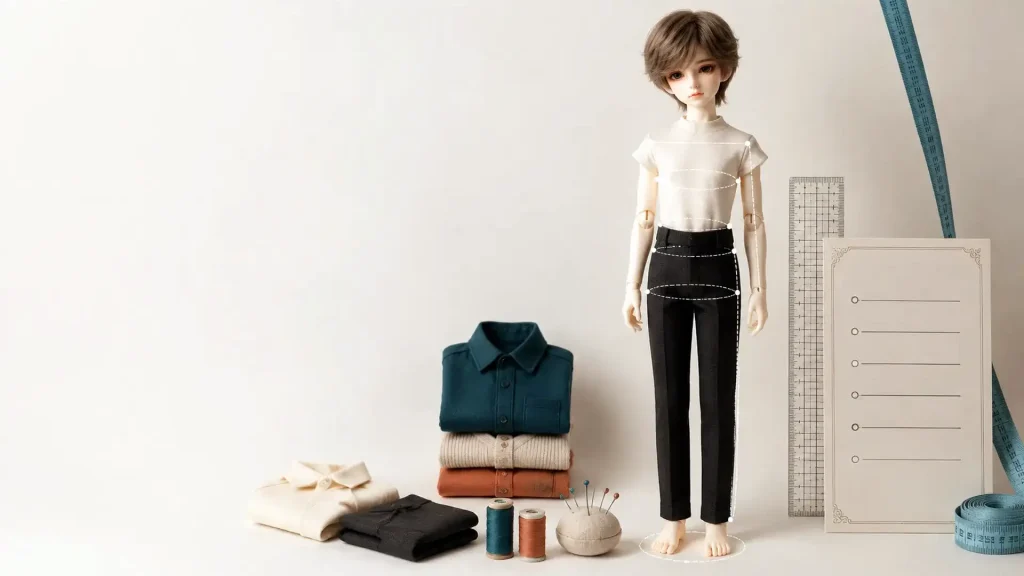
BJD Clothing Size Guide: How to Choose Clothes That Fit
This BJD clothing size guide explains how to choose clothes by comparing your doll’s actual measurements with the finished garment measurements. Labels such as MSD, SD, 1/4, 1/3, and YoSD are useful starting points, but they are not universal fit standards. A garment can match a doll’s general size category and still fail at the shoulders, chest, waist, hips, thighs, rise, closures, sleeves, or shoes.
Quick Answer: How Do You Choose BJD Clothes That Fit?
Use the size label to find candidates, then use measurements to decide. The most reliable process is:
- Identify the doll’s broad category, such as YoSD, MSD, SD, 1/4, or 1/3.
- Identify the doll’s body type and measure the areas relevant to the garment.
- Compare those measurements with the seller’s finished garment measurements.
- Check fabric stretch, recovery, closures, openings, layering, and intended silhouette.
- Ask the seller for missing measurements or fit information before ordering.
Do not ask only whether an item is “MSD size” or “1/4 size.” Ask which body model the garment was made for, what its actual measurements are, and how closely your doll matches that body.
A fit decision has two measurement sides: the body being dressed and the garment doing the dressing. Measurements reduce uncertainty, but they cannot fully predict the result when the pattern, fabric behavior, closure, or measurement method is unknown.
Are BJD Clothing Sizes Universal?
No. BJD clothing labels are broad search categories used by makers, sellers, and collectors. They help you locate potentially suitable clothing, but they do not guarantee identical proportions across brands or body models.
Two dolls may both be described as MSD or 1/4 while having different shoulder widths, busts, waists, hips, thighs, torso lengths, arm lengths, or feet. The same is true of SD and 1/3 dolls. Slim, mature, childlike, muscular, and fantasy bodies can require different patterns even when their heights are similar.
A size label narrows the search; measurements make the fit decision. When important measurements are missing, treat the purchase as uncertain and ask the seller for clarification.
Common BJD Size Labels and Their Limits
Scale labels and community size names often overlap in shopping language, but they should not be treated as strict cross-brand clothing standards. This guide is part of the broader BJD Library, which organizes the core topics new collectors need to understand before choosing dolls, accessories, and configurations. For broad height and size orientation, see the BJD Size Chart. For related terminology, see the BJD Glossary.
| Common Label | What It Helps You Estimate | What It Cannot Guarantee | What to Check Instead |
|---|---|---|---|
| MSD / 1/4 | A general mid-size clothing search category. | Identical chest, shoulder, hip, thigh, torso, or leg proportions. | Body type, bust, shoulders, waist, hips, thighs, rise, and the garment’s fit model. |
| SD / 1/3 | A general larger-doll clothing search category — see 1/3 BJD dolls for verified models. | Identical bust, shoulders, hips, arm length, inseam, or foot shape. | Actual body measurements and finished garment measurements. |
| YoSD / Tiny | A small-doll search category, often associated with childlike proportions. | Identical height, torso shape, head size, limb proportions, or clothing fit. | The specific doll’s measurements and the garment’s intended body model. |
| 1/6, 1/8, or similar fraction labels | A broad scale or size reference used in some listings. | A common clothing pattern or exact compatibility. | Height, body dimensions, garment measurements, and seller notes. |
| Maker-specific body label | A garment designed around a named body or product line. | Fit on another maker’s body with the same general label. | The named fit model and the completed garment measurements. |
MSD and 1/4 often overlap in shopping language, but they are not strict synonyms. SD and 1/3 are used in a similar way. These labels are useful for finding possible matches, not for replacing measurement checks.
How to Measure a BJD for Clothing
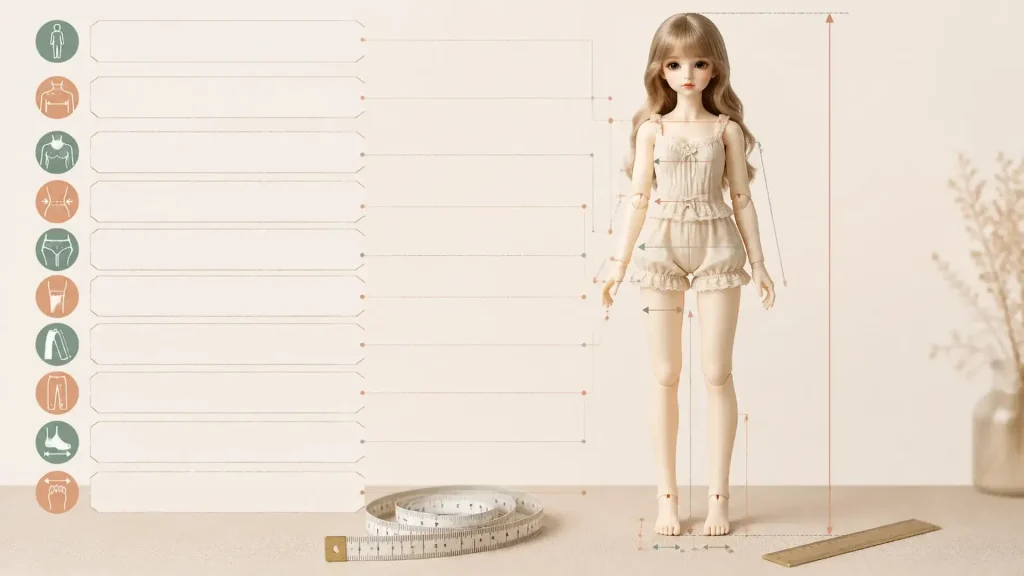
Use a flexible measuring tape when possible. Record measurements in centimeters or inches, together with the date, position, and method used. Remove bulky clothing and place the doll in a neutral, repeatable position. Keep the tape level and snug without compressing the resin or pulling the tape tight.
If a seller gives a specific measuring method, use that method when comparing figures. There is no single universal way to report every BJD measurement, especially shoulder width, rise, sleeve length, or garment length.
| Body Measurement | General Measuring Guidance | Most Relevant For |
|---|---|---|
| Height | Record total height in the position used by the maker or seller. | General category, garment length, and display planning. |
| Shoulder width | Use the maker’s stated landmarks. Shoulder measurements are not reported in one universal way. | Shirts, jackets, coats, dresses, and fitted tops. |
| Chest or bust | Measure around the fullest relevant part, keeping the tape level. | Tops, jackets, dresses, bodices, and underwear. |
| Waist | Measure around the point where the garment waistband is intended to sit. | Pants, skirts, dresses, and fitted garments. |
| Hips or seat | Measure around the fullest part of the lower torso. | Pants, skirts, dresses, and underwear. |
| Thigh | Measure around the fullest relevant part of the upper thigh. | Pants, shorts, leggings, and fitted underwear. |
| Upper arm and wrist | Measure the widest parts and note hand size where sleeves must pass over the hand. | Fitted sleeves, cuffs, gloves, and armholes. |
| Arm length | Follow the seller’s stated start and end points. | Long sleeves, shirts, jackets, and coats. |
| Neck | Measure where a collar or high neckline is intended to sit. | Collared shirts, turtlenecks, and high-neck dresses. |
| Rise | Compare only when the doll and garment use comparable starting and ending points. | Pants, shorts, trousers, and underwear. |
| Inseam | Measure from the crotch point to the intended hem position. | Pants, trousers, and shorts. |
| Foot length and width | Measure the longest foot dimension and the widest part of the foot. | Shoes, boots, socks, and fitted footwear. |
Not every garment needs every measurement. A loose open-front cardigan may not require the same checks as a tailored jacket or fitted pair of trousers. Measure according to the garment’s construction and the way it will be worn.
How to Read BJD Garment Measurements
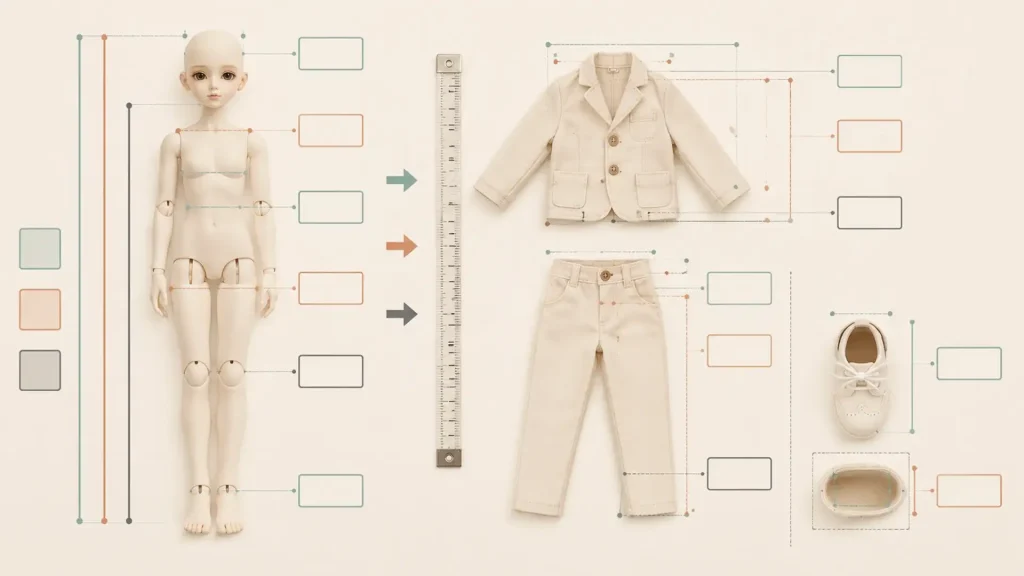
A doll body measurement describes the body. A finished garment measurement describes the completed clothing. A recommended body measurement describes the range or model the seller expects the garment to fit. These figures are related, but they are not interchangeable.
| Seller’s Measurement | What It Usually Means | What to Watch For |
|---|---|---|
| Flat measurement | A width measured while the garment is laid flat. | It is not automatically a circumference. Shaping, seams, gathers, and closures affect the result. |
| Circumference | The measurement around the body or garment at a stated point. | Make sure the comparison uses the same point and measuring method. |
| Finished garment measurement | The actual size of the completed garment. | It may not include usable room at openings, cuffs, or closures. |
| Recommended body measurement | The doll measurements the seller expects the garment to fit. | Check whether your doll has the same body shape as the seller’s model. |
| Insole length | The usable interior length of a shoe. | Usually more relevant to fit than the outer sole length. |
| Outer sole length | The exterior length of the shoe. | It may be larger than the usable interior space. |
A flat width can sometimes be doubled as a rough estimate for a simple, symmetrical section, but it is not a reliable circumference calculation for shaped garments. Curved seams, darts, pleats, elastic, gathered fabric, lining, and stretch can all make simple doubling misleading.
Ease, Stretch, and Practical Fit
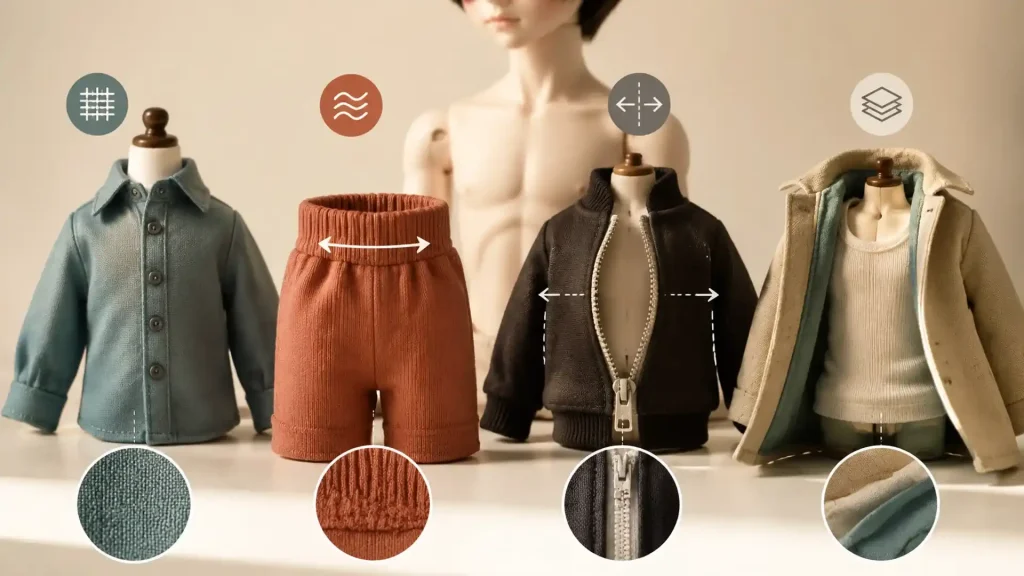
Ease is the difference between the doll’s body dimensions and the finished garment dimensions. The appropriate amount depends on the garment’s intended silhouette, fabric, construction, and closure. There is no universal BJD clothing allowance that works for every pattern.
| Fabric or Construction | Possible Fit Effect | What to Check |
|---|---|---|
| Non-stretch woven fabric | Usually needs room at critical points because it cannot expand much. | Chest, shoulders, hips, thighs, openings, and closure position. |
| Stretch fabric | May allow a closer fit. | Stretch direction, recovery, seam strength, cuffs, and openings. |
| Elastic waistband | Can accommodate some variation at the waist. | Unstretched and stretched measurements, recovery, and hip clearance. |
| Buttons, hooks, or zipper | The garment may have less usable room than its overall measurement suggests. | Closed size, opening width, and whether the doll can pass through the opening. |
| Thick lining or layered clothing | Adds bulk and reduces available room. | Whether the outer garment was designed to fit over the planned layers. |
| Oversized pattern | Provides intentional room, but may change the garment’s proportions on a different body. | Shoulder placement, sleeve length, neckline, and overall length. |
Stretch does not make measurements irrelevant. A fabric may stretch across the chest but not at the cuff, waistband, armhole, or closure. Poor recovery can also lead to distortion or bagging. Judge stretch together with construction and the path the garment must take when it is put on.
Practical Fit = Body Dimensions + Garment Dimensions + Garment Behavior. This is an editorial decision model, not a mathematical sizing formula.
Clothing-Specific Fit Checks
Tops, Shirts, and Jackets
Check shoulder width, chest or bust, armholes, sleeve length, cuff opening, neck opening, closure type, and garment length. Chest measurement alone is not enough. A top can fit the bust but pull backward at the shoulders, restrict the armholes, or fail to close at the front.
Dresses and Skirts
Check bust, waist, shoulder or neck opening, closure position, waistline placement, and length. If a petticoat or underskirt will be worn, include that extra bulk in the fit plan. A dress can fit the circumference but look too long or too short because the doll’s torso and leg proportions differ from the fit model.
Pants, Trousers, and Shorts
Check waist, hips, thighs, rise, inseam, leg opening, and closure. Waist fit does not guarantee hip, thigh, or rise fit. Trousers may stop at the hips, bind at the thighs, or sit too high or low when the rise is wrong.
Underwear and Base Layers
Check chest, waist, leg openings, arm openings, stretch, recovery, and the amount of bulk added beneath the outer clothing. A base layer that fits by itself may make a tailored outer garment too tight.
Shoes and Boots
Shoes are a separate fit problem. Check foot length, foot width, toe shape, instep height, shoe opening, and whether the listed measurement refers to the insole or outer sole. Add room for socks or stockings if they will be worn. Boots and high-top shoes also need enough opening space for the foot to enter.
Outerwear and Layering
Judge outerwear over the layers the doll will actually wear. Check shoulders, armholes, sleeve length, closure clearance, and thickness. A coat that fits over a thin shirt may not fit over a sweater, petticoat, or structured outfit.
The Two-Sided Fit Check
The Two-Sided Fit Check is a simple method for comparing the doll and the garment as two parts of the same decision. It is an editorial framework created for this guide, not an official industry standard.
| Doll Side | Garment Side |
|---|---|
| Chest, waist, hips, shoulders, and thighs | Finished chest, waist, hips, shoulders, and thighs |
| Arm length, upper arm, wrist, rise, and inseam | Sleeve length, cuff opening, rise, inseam, and leg opening |
| Foot length, width, instep, and socks | Insole length, usable width, instep space, and shoe opening |
| Body type, posture, joint shape, and planned layers | Fabric, stretch, lining, closure, construction, and intended silhouette |
If either side is unknown, the fit decision is incomplete. You may still decide to accept the uncertainty, but it should be a conscious decision rather than an assumption based on the size label alone.
The Bottleneck Measurement Principle
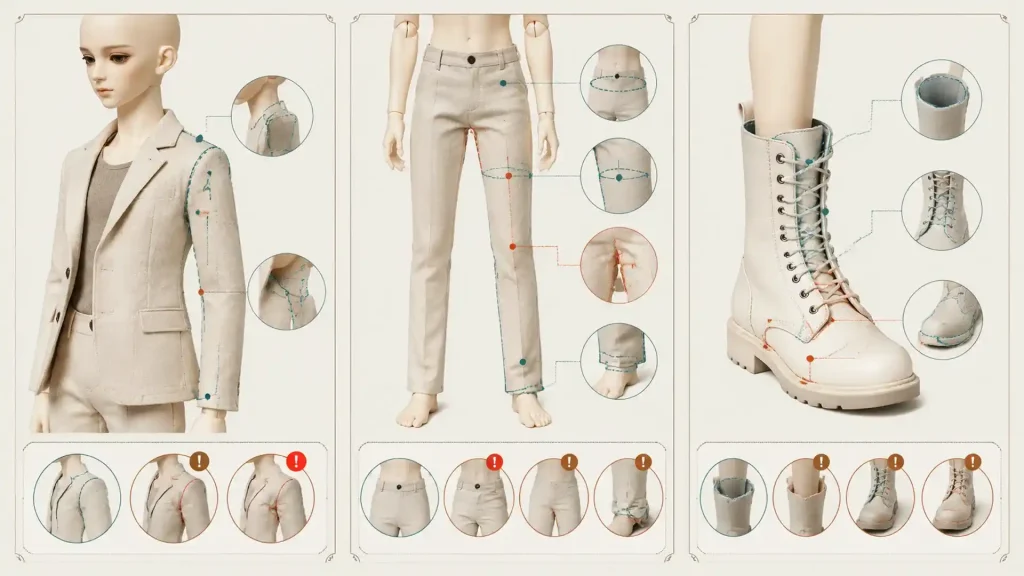
A garment may fit most areas and still be impractical to wear because one limiting point prevents it from being put on, closed, or positioned correctly. This is the Bottleneck Measurement Principle, an editorial framework for identifying the most important risk before purchase.
The smallest critical opening or the largest relevant body measurement can determine whether a garment is practically wearable. The controlling measurement depends on the garment’s construction.
| Garment | Common Bottleneck | Verification Point |
|---|---|---|
| Shirt or jacket | Shoulder width, chest, armhole, or closure | Can the garment sit correctly and close without strain? |
| Dress | Neck opening, shoulder width, bust, or waist | Can it pass over the head or body and fasten at the fitted points? |
| Pants | Hips, thighs, rise, or waistband opening | Can the garment pull up fully and sit at the intended waist? |
| Sleeves | Upper arm, wrist opening, or hand size | Can the sleeve pass over the hand and sit without binding? |
| Shoes | Foot width, insole length, instep, or opening | Does the usable interior space match the foot and any socks? |
| Boots | Opening width, instep, or calf area | Can the foot enter and sit correctly inside the boot? |
Body Shape and Cross-Brand Compatibility
Dolls with similar heights may need different clothing because their proportions are different. Common variables include childlike versus mature bodies, standard versus slim builds, narrow versus broad shoulders, bust size, waist-to-hip ratio, muscular thighs, torso length, limb length, and unusual fantasy anatomy.
| Body Difference | Areas Most Affected | What to Compare |
|---|---|---|
| Broad shoulders | Tops, jackets, coats, and dresses | Shoulder width and armhole dimensions |
| Larger bust | Tops, dresses, jackets, and underwear | Chest or bust circumference and closure position |
| Fuller hips or thighs | Pants, skirts, dresses, and underwear | Hip, thigh, rise, and waistband measurements |
| Long or short torso | Tops, dresses, and pants | Garment length, waist placement, and rise |
| Long arms or legs | Sleeves and pants | Sleeve length and inseam |
| Large hands or feet | Gloves, sleeves, shoes, boots, and socks | Openings, foot length, foot width, and instep |
| Fantasy body parts | Any garment covering unusual anatomy | Custom measurements and garment construction |
Cross-brand compatibility is possible, but it is not guaranteed by a shared scale label. A maker’s recommended body is useful evidence, but compare actual figures whenever they are available.
Fit Troubleshooting: When Clothing Does Not Fit
A poor fit can have more than one cause. Use the table below as a starting point rather than a definitive diagnosis.
| Symptom | Possible Cause | What to Check Next |
|---|---|---|
| Shirt will not close | Insufficient chest, shoulder, or closure room | Finished chest, shoulder width, closure position, and opening size |
| Shoulders pull backward | Garment shoulders or armholes are too narrow | Shoulder width, armhole shape, and sleeve attachment |
| Sleeves are too short | Different arm length or sleeve measurement method | Arm length, sleeve length, cuff position, and intended styling |
| Pants stop at the hips | Insufficient hip, thigh, or opening room | Hip, thigh, rise, waistband, and closure opening |
| Pants fit the waist but bind at the thighs | Thigh circumference or leg shape is larger than the pattern allows | Thigh measurements and the garment’s leg width |
| Dress fits the body but cannot be put on | Neck, shoulder, hand, or closure opening is too small | Put-on path, opening dimensions, and whether hands can be removed |
| Waistband gaps | Waist shape, elastic recovery, or closure does not match | Finished waist measurement, elastic behavior, and closure |
| Clothing shifts during posing | Loose fit, smooth resin, missing fastener, or unsuitable shape | Garment structure, friction points, closures, and pose used |
| Shoes fit in length but not width | Narrow footbed, toe shape, or insufficient instep room | Interior width, insole length, toe shape, and instep |
| Clothing fits without layers but not with them | Outer garment lacks room for the actual underlayers | Layer thickness, armholes, shoulders, and closure clearance |
Questions to Ask a Clothing Seller
When a listing provides only a broad size label, ask for the information that affects the actual fit:
- What are the finished garment measurements for the chest, waist, hips, shoulders, sleeves, and length?
- Was the garment tested on a specific doll body or fit model?
- Is it intended for a slim, mature, childlike, muscular, or standard body?
- Does the fabric stretch, and how well does it recover after stretching?
- What is the closure type, and how wide does the opening become?
- For pants, what are the waist, hip, thigh, rise, inseam, and leg-opening measurements?
- For shoes, is the listed length the insole length or the outer sole length?
- What are the shoe width, instep clearance, and boot opening?
- Will the garment fit over socks, stockings, petticoats, or other planned layers?
- Are the measurements taken flat, around the garment, or according to another method?
Common BJD Clothing-Buying Mistakes
- Treating a size label as a universal standard. Use MSD, SD, or 1/4 as a search clue, then compare measurements.
- Measuring the doll but not the garment. A body record cannot show whether the garment has the necessary room or openings.
- Comparing flat and circumference measurements incorrectly. Confirm how the seller measured before converting or doubling a figure.
- Ignoring shoulder width. Tops may fail at the shoulders even when the chest appears suitable.
- Ignoring hips, thighs, and rise for pants. Waist and inseam are not enough to judge trousers.
- Ignoring closures and openings. A garment may fit the body but fail to pass over the head, hands, feet, or hips.
- Buying shoes by scale only. Foot length, width, instep, interior space, and opening all matter.
- Assuming two dolls of the same height share clothing. Body proportions can differ substantially.
- Treating product photos as proof of fit. Photos may not reveal strain, closure problems, or the exact fit model.
- Ignoring fabric behavior. Stretch, recovery, stiffness, lining, and thickness affect practical fit.
- Ignoring layers and undergarments. An outer garment must be judged over the clothing the doll will actually wear.
- Assuming the seller’s model body matches your doll. Ask which body was used for testing.
- Not recording the measurement method. A number without its landmarks or position may be difficult to compare later.
- Assuming a small alteration can fix every mismatch. Some differences involve shoulders, armholes, rise, closures, or overall pattern shape.
- Failing to ask questions when only a broad label is provided. Missing information is a reason to clarify, not a reason to guess.
- Buying for a future body without checking compatibility. Clothing that fits one body may not fit after a body swap or hybrid build.
Buyer Worksheet and Measurement Record
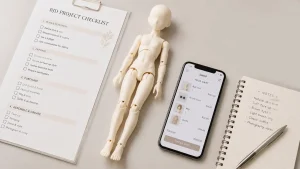
This worksheet is a practical tool created for this guide, not an official industry form. Record the date, position, and method so the measurements can be repeated consistently.
DOLL MEASUREMENT RECORD

Maker:
Sculpt:
Body model:
Measurement date:
Measurement position:
Measurement method or notes:

Height:
Shoulder width:
Chest / bust:
Waist:
Hips / seat:
Thigh:
Upper arm:
Wrist:
Arm length:
Neck:
Rise:
Inseam / leg length:
Foot length:
Foot width:
Instep:

GARMENT RECORD

Seller / maker:
Product name:
Product URL:
Advertised size or label:
Garment type:
Recommended body or fit model:
Finished garment measurements:
Flat or circumference measurement method:
Closure type:
Stretch and recovery notes:
Lining or thickness notes:
Layering notes:
Main bottleneck to check:
Questions sent to seller:
Seller's reply:
Return or exchange terms:
Decision:
Final BJD Clothing Purchase Checklist
- Use the broad label only to find possible clothing.
- Confirm the exact doll body and body type.
- Measure the body areas relevant to the garment.
- Compare body measurements with finished garment measurements.
- Confirm how the seller measured flat widths, circumferences, lengths, rises, and shoes.
- Check shoulders, bust, waist, hips, thighs, openings, sleeves, rise, and inseam as relevant.
- Check fabric stretch, recovery, stiffness, lining, thickness, and closures.
- Allow for socks, stockings, petticoats, underwear, or other layers.
- For shoes, check insole length, usable width, toe shape, instep, and opening.
- Identify the most likely bottleneck before ordering.
- Ask the seller for missing measurements or fit-model information.
- Save the product page, measurements, seller answers, and return or exchange terms.
For the broader pre-purchase process, see the First BJD Buying Checklist.
Frequently Asked Questions
Are BJD clothing sizes universal?
No. Labels such as MSD, SD, 1/4, 1/3, and YoSD are useful search categories, but they do not guarantee identical proportions across makers. Compare the doll’s relevant body measurements with the garment’s finished measurements, fabric behavior, closures, and intended silhouette.
Does MSD clothing fit every 1/4 BJD?
No. MSD and 1/4 often overlap in shopping language, but dolls in this broad range can have childlike, slim, mature, or other body proportions. Check shoulders, bust, waist, hips, thighs, rise, and the seller’s fit model before ordering.
Does SD clothing fit every 1/3 BJD?
No. SD and 1/3 are broad references rather than universal clothing standards. Body height, shoulders, bust, waist, hips, limb length, and foot shape can differ. Use the specific doll and garment measurements instead of relying on the label alone.
What measurements should I take for BJD clothes?
Depending on the garment, measure height, shoulders, chest or bust, waist, hips, thighs, upper arm, wrist, arm length, neck, rise, inseam, foot length, foot width, and instep. You do not need every measurement for every garment, but you should check every likely bottleneck.
Should I measure the doll or the clothing?
Both. The doll’s measurements describe the body being dressed, while the garment’s finished measurements describe the available space and openings. A reliable fit decision also considers fabric stretch, recovery, lining, closures, and how the garment is intended to be worn.
What is ease in BJD clothing?
Ease is the difference between the doll’s body dimensions and the finished garment dimensions. The appropriate amount varies by garment, fabric, construction, and intended silhouette. Non-stretch tailored clothing usually needs room at important points, while some stretch garments can be designed for a closer fit.
Does stretch fabric make measurements less important?
No. Stretch may allow a closer fit, but the direction and amount of stretch, recovery, seam strength, cuffs, waistbands, armholes, and closures still matter. A garment may stretch across the chest but remain too tight at the wrists or openings.
Why does a shirt fit the chest but not the shoulders?
The chest and shoulder areas are separate fit points. A garment can have enough chest room while its shoulders, armholes, sleeve attachment, or back width are too narrow. Compare shoulder width and armhole construction in addition to the chest measurement.
Why do BJD pants fit the waist but not the hips?
The waistband does not determine the fit of the entire pair of trousers. Hips, thighs, rise, leg shape, and the opening through which the pants are put on may all limit fit. Check the full set of relevant measurements rather than waist and inseam alone.
How do I choose BJD shoes?
Compare the doll’s foot length and width with the shoe’s usable interior space. Check whether the seller gives insole or outer sole length, and consider toe shape, instep, opening size, socks, and stockings. Scale labels alone are not enough for reliable shoe fit.
Do childlike, slim, and mature BJDs share clothing?
Sometimes, but not automatically. These body types can differ in shoulders, bust, waist, hips, torso, thighs, and limbs. A garment may fit one body type and fail on another at the shoulders, waist, hips, rise, or length.
Can BJD clothes fit across brands?
Yes, cross-brand compatibility is possible, but it is not guaranteed by a shared size label. Compare the actual doll and garment measurements, body proportions, construction, and fit model. Maker-specific clothing may be shaped around one body line rather than a broad category.
What should I do if a seller gives only an MSD or SD label?
Ask for finished garment measurements, the body or fit model used, fabric stretch, closure details, and any body-type notes. If the seller cannot provide enough information for a purchase that depends on precise fit, recognize that the uncertainty remains part of the decision.
Can photos prove that clothing will fit?
No. Photos can show the general silhouette, but they may not reveal strain, hidden closures, tight armholes, insufficient rise, or the exact body used for the sample. Use photographs as context and measurements and seller information as the main fit evidence.
What should I check when buying BJD clothes secondhand?
Ask for the garment’s current measurements, condition, stretch, stains, repairs, closures, and the body it previously fit. Confirm whether it has been altered or stretched through use. Compare it with your doll’s measurements rather than assuming the original size label still provides enough information.
What is the safest way to reduce clothing-fit mistakes?
Use the label to find candidates, measure the doll, measure or obtain the garment measurements, identify the likely bottleneck, account for fabric and layers, and ask precise questions before buying. Save the seller’s answers and the product information so the decision can be reviewed later.
Conclusion: Use Labels to Search and Measurements to Decide
BJD clothing labels are useful for finding possible garments, but they are not universal fit guarantees. Actual body measurements, finished garment measurements, body shape, ease, fabric behavior, closures, and layering all affect whether an item can be worn and how it will look.
Remember the central rule: measure the body being dressed and the garment doing the dressing. Then look for the likely bottleneck, such as shoulders, bust, hips, thighs, rise, openings, foot width, or instep.
No guide can guarantee a perfect fit when important information is missing. A careful buyer reduces risk by asking specific questions, recording the measurement method, and treating uncertainty honestly. Use the label to find candidates, then use measurements to decide.