BJD Wig Size Guide: How to Choose the Right Wig Fit
Choosing a BJD wig is not as simple as matching a label such as MSD, SD, YoSD, 1/4, or 1/3. These labels can help you find suitable candidates, but they are not universal compatibility standards. A wig that fits one doll in a particular size category may be too loose, too tight, too deep, or visually disproportionate on another.
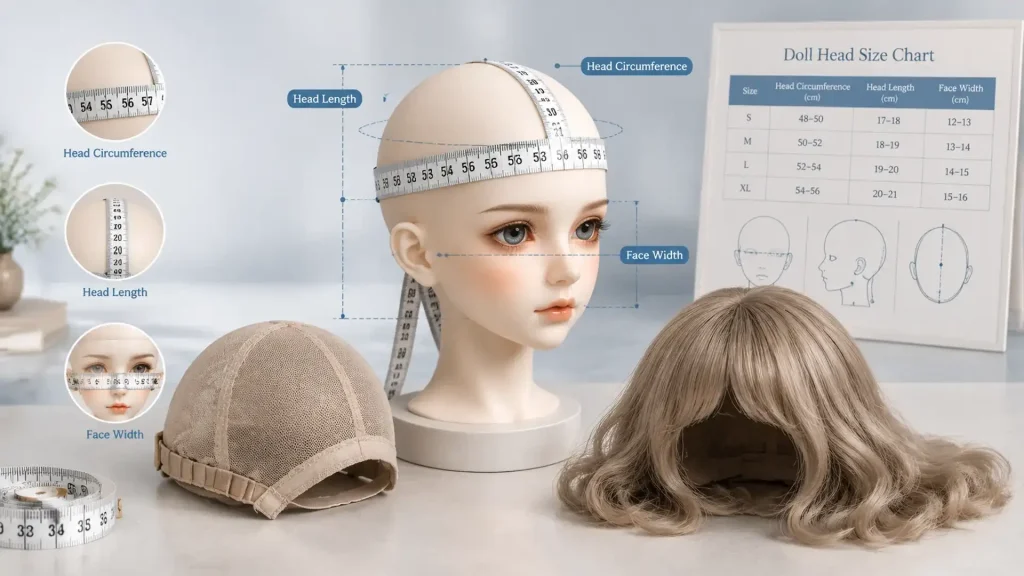
The safest approach is to measure your doll’s head using a consistent method, compare that measurement with the seller’s stated method and recommended range, and then check the wig’s cap shape, depth, opening, adjustment system, hair density, and intended hairstyle.
Head circumference helps locate a wig; cap construction determines how it wears.
A useful fit decision has four parts:
- Head measurement: Does your doll’s head fall within the seller’s stated range?
- Cap compatibility: Do the opening, depth, shape, and adjustment system suit the head?
- Hairstyle load: Will the hair’s weight and volume affect stability?
- Visual proportion: Does the hairline, density, and silhouette suit the sculpt?
A wig can fit physically and still look too bulky, too shallow, too deep, or out of proportion. For that reason, the advertised size is only the beginning of the decision.This guide is part of our BJD Library, a broader learning resource covering BJD sizes, terminology, buying decisions, and fit-related questions.
What Is the Safest Way to Choose a BJD Wig?
Use the following process before ordering:
- Identify the exact doll head or sculpt, not only the doll’s height or broad size category.
- Measure the head and record the measurement path, unit, and date.
- Read the seller’s size chart and determine what each number actually measures.
- Compare your doll’s measurement with the seller’s recommended head range.
- Check cap depth, cap opening, head shape, adjustment range, and hair density.
- Consider the hairstyle you intend to use, including bangs, ponytails, braids, and added volume.
- Evaluate physical security and visual proportion as two separate questions.
- Check the seller’s inspection, return, and exchange terms before opening or modifying the wig.
If the seller provides a measurement diagram, fit-model information, or product-specific notes, use those details rather than assuming that every seller uses the same sizing method.
How to Measure a BJD Head for a Wig
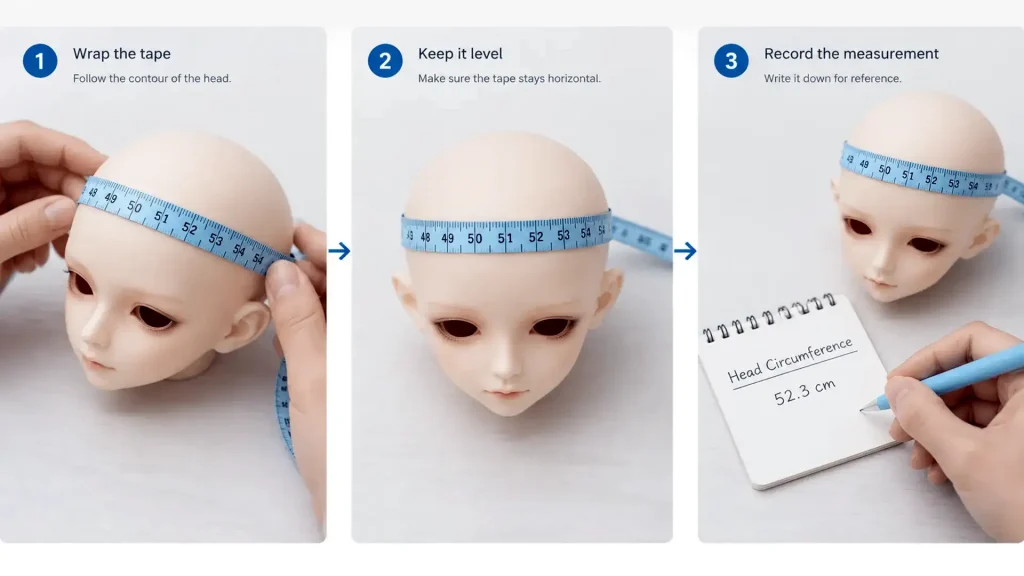
Use a flexible measuring tape that follows the contours of the head without leaving gaps or compressing the surface. Remove an existing wig, wig cap, padding, and accessories unless the seller specifically asks you to measure with a particular layer in place.If you are still learning how BJD body and head measurements are recorded, start with our BJD Size Chart before comparing a doll with a wig listing. The chart provides broader size context, while this guide focuses specifically on wig-related head fit.
There is no single measurement path used by every BJD wig seller. When a seller provides a diagram or written method, follow it as closely as possible. If no method is provided, use a consistent practical circumference around the fullest part of the head and record the route you used.
A common starting method is to place the tape across the forehead, around the widest practical contour of the head, and around the fullest part of the back. Do not treat this description as a universal industry standard. The important point is that your measurement and the seller’s measurement should use comparable landmarks.
- Use a flexible tape. A rigid ruler is difficult to use accurately around a curved head.
- Keep the tape level. Avoid twisting, slanting, or changing the route between attempts.
- Keep the tape snug, not tight. It should follow the surface without compressing the head.
- Repeat the measurement. Take two or three readings using the same method if the result is uncertain.
- Record the details. Note centimeters or inches, the date, and the measurement path.
- Record unusual features. A broad forehead, prominent crown, flat back, deep head, or unusual contour may affect cap fit even when circumference appears suitable.
Do not measure over a thick wig cap or hairstyle unless the seller’s chart is specifically designed for that additional layer. If you plan to use a wig cap, padding, or another protective layer, allow for it separately and check how much space it adds.
What Do BJD Wig Size Labels Mean?
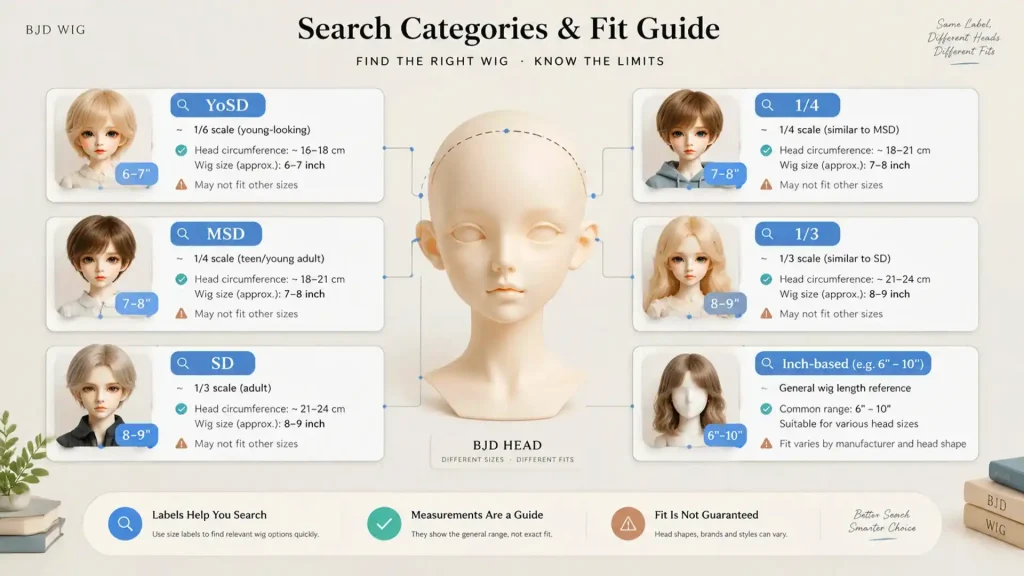
BJD wigs are commonly listed with terms such as MSD, SD, YoSD, 1/4, 1/3, 7–8 inches, or 8–9 inches. These labels are useful search categories, but they do not function as universal sizing standards.Some of these labels are community terms rather than strict industry standards. For definitions of common BJD terms such as MSD, SD, YoSD, sculpt, and related collecting language, see the BJD Glossary.
Scale terms such as 1/4 and 1/3 primarily describe a doll’s general body scale or height proportion. They do not define one exact head circumference, head shape, cap depth, or wig compatibility. Dolls in the same broad category can have different forehead shapes, crown heights, back-of-head contours, and proportions.
Inch ranges also need interpretation. Depending on the seller, a number may describe:
- the recommended head circumference;
- the physical circumference of the wig cap;
- the cap opening;
- an internal maker-specific category;
- or another measurement defined in the product listing.
A wig label narrows the search; the doll’s measurements and the wig’s construction make the fit decision.
Broad Search Categories, Not Fit Standards
| Label | What It Usually Helps You Find | Why It Is Not Enough | What to Verify |
|---|---|---|---|
| YoSD / Tiny | Smaller-doll wig listings | Small heads can still differ in circumference, depth, and shape | Head measurement, cap depth, opening, and fit model |
| MSD / Mini | Mid-size or broadly 1/4-related wig listings | Different 1/4 bodies and head sculpts may use different proportions | Recommended head range, cap construction, and adjustment range |
| SD / Standard | Larger-doll wig listings | SD labels do not describe one universal head size or shape | Head circumference, cap depth, opening, and head-shape compatibility |
| 1/4 or 1/3 | Broad scale-based search results | Scale does not determine exact wig compatibility | The specific doll head and the product’s measurements |
| 7–8 inch or 8–9 inch | Seller-defined inch-based wig categories | The number may refer to different parts of the wig depending on the seller | What the number measures and how it was obtained |
Two wigs with the same label may differ in cap depth, opening, elasticity, internal structure, fiber density, and overall volume. Likewise, two dolls with the same label may require different wigs. Treat the label as a filter, not a fit guarantee.
Recommended Head Size, Cap Size, and Cap Opening Are Not the Same
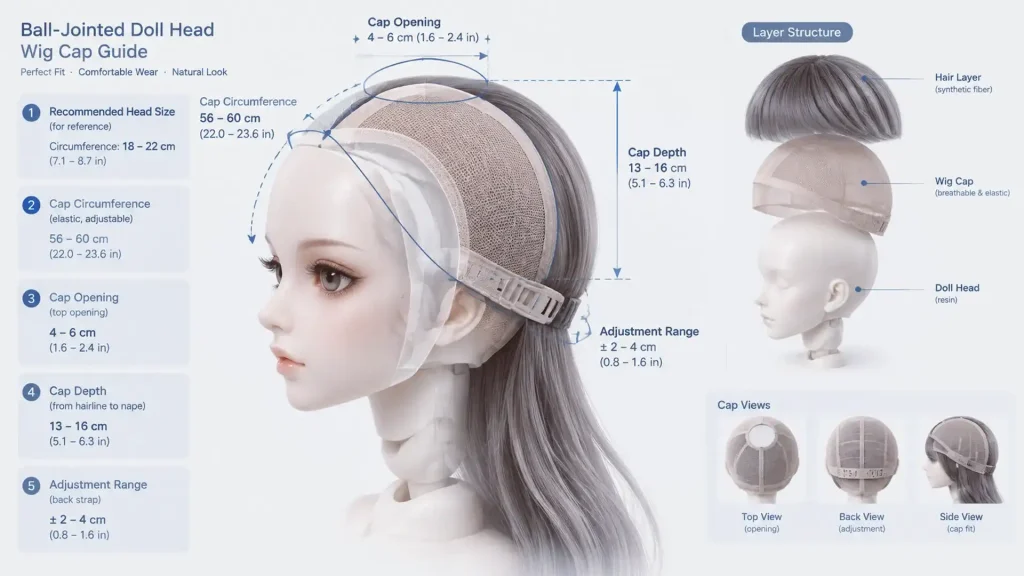
One of the most common sources of confusion is assuming that every number in a wig listing describes the same thing. It does not.
| Term | What It Usually Refers To | Why It Matters |
|---|---|---|
| Recommended head size | The range of doll head measurements the seller expects the wig to fit | Useful for initial compatibility, but dependent on the seller’s method and fit model |
| Cap circumference | The measured circumference of the wig cap | May not be equal to the recommended head circumference |
| Cap opening | The opening through which the wig is placed on the head | Affects whether the wig can pass over the widest part and settle correctly |
| Cap depth | The amount of coverage from the crown toward the hairline and back of the head | Affects hairline position, facial coverage, gaps, and stability |
| Adjustment range | How much the wig can be tightened or loosened | May accommodate small differences, but cannot correct every shape mismatch |
Before comparing a measurement, ask what it describes. A doll head measurement cannot be compared confidently with a cap opening unless both measurements use compatible landmarks and methods.
How to Read a BJD Wig Size Chart
Read the size chart together with the individual product listing. A general chart may describe the seller’s broad categories, while a particular wig may have a different cap construction, hairstyle, adjustment system, or fit model.
Use the following order:
- Find the definition. Determine whether the listed number refers to a recommended head range, cap circumference, opening, or another measurement.
- Confirm the unit. Check whether the seller uses inches, centimeters, or both.
- Compare the method. Make sure your head measurement and the seller’s figure refer to comparable routes or landmarks.
- Check the range position. A head measurement near the center of a range is usually easier to assess than one at the edge, but construction still matters.
- Read the product notes. Look for information about cap depth, elasticity, hair density, fit models, and intended doll types.
- Ask before ordering. If a key measurement is missing, ask the seller rather than guessing.
What If My Head Is Near or Outside the Listed Range?
| Situation | Practical Decision |
|---|---|
| Your head is comfortably within the seller’s recommended range | Continue checking cap depth, head shape, opening, adjustment, and hairstyle weight. |
| Your head is close to the upper or lower edge of the range | Ask for cap opening, cap depth, adjustment range, and fit-model measurements. |
| Your head is outside the stated range | Treat the purchase as higher risk unless the seller confirms compatibility. |
| Only a broad label is provided | Do not treat the wig as confirmed compatible without further information. |
Recommended Wig Size Is Not Always the Only Possible Size
A seller’s recommended size usually describes the most predictable fit for a particular head model or range. It may be based on the head used in the sample photos, the maker’s preferred cap tension, or the construction of that particular wig.
This does not automatically mean that every other size is impossible. A wig with a suitable opening, cap depth, adjustment system, and head shape may work for a nearby measurement even when it is not the seller’s primary recommendation.
However, this principle should not be misunderstood. “Not the only possible size” does not mean “any size can work.” A wig outside the seller’s stated range remains uncertain unless the seller confirms it. Adjustment hardware can help with small differences, but it cannot reliably fix a cap that is fundamentally too shallow, too deep, too narrow, or shaped differently from the doll’s head.The same principle applies to BJD clothing: a broad size label can help you find candidates, but actual body and garment measurements are what support the final fit decision. See the BJD Clothing Size and Fit Guide for a parallel approach to clothing compatibility.
Wig Construction Factors That Affect Fit
Once the head measurement is reasonably understood, examine the wig itself. The following features can determine whether the wig sits correctly and remains stable.
| Wig Feature | Why It Matters | What Can Go Wrong |
|---|---|---|
| Cap depth | Controls coverage from the crown toward the hairline and back of the head | The hairline sits too low, the crown is exposed, or the cap leaves gaps |
| Cap opening | Affects placement over the widest part of the head | The wig is difficult to put on or settles too loosely |
| Cap shape | Determines how closely the wig follows the head contour | A matching circumference still produces gaps, rotation, or poor stability |
| Elastic or adjustment system | Allows limited tightening or loosening | The wig slides, rotates, creates excessive pressure, or cannot be secured |
| Hair density | Changes weight, volume, and apparent head size | The style looks sparse, heavy, or disproportionately large |
| Fiber direction | Controls how the hair leaves the cap and frames the face | Side volume, bangs, or the intended silhouette look different from the photo |
| Wig thickness | Affects both cap bulk and the final hairstyle | The head appears larger or the hairline sits farther from the face |
| Internal structure | Influences how the cap and fibers hold their shape | The wig loses its intended form or becomes unstable during handling |
Cap Depth and Hairline Position
Cap depth is separate from circumference. A wig may match the doll’s head measurement while still sitting too low on the forehead or leaving part of the crown exposed.
This is particularly noticeable with short styles and straight bangs. A deep cap may push the hairline downward and make the face appear smaller. A shallow cap may expose part of the head or create visible gaps near the crown and sides.
Cap Opening and Practical Placement
The opening is the route through which the wig is placed on the head. It may not correspond directly to the listed recommended head size. A wig can have a suitable overall range but still be difficult to position if the opening is restrictive or shaped differently from the head.
Elastic and Adjustment Systems
Elastic, hooks, straps, or other adjustment systems may help accommodate small variations. They do not correct every mismatch in head depth, cap shape, or opening. Excessive tightening can also distort the hairline or change the intended style.
Hair Density, Volume, and Fiber Direction
Dense hair adds weight and visual volume. Fibers that project outward create a different silhouette from fibers designed to lie close to the head. Long hair, thick bangs, ponytails, and braids may also change how the wig behaves after styling.
The measurement that looks most convincing on a size chart is not always the point that causes trouble in use. A wig may match the listed circumference but still sit poorly because the cap is too deep, the opening is shaped differently, or the hairstyle pulls the cap backward.
The Four-Part BJD Wig Fit Check
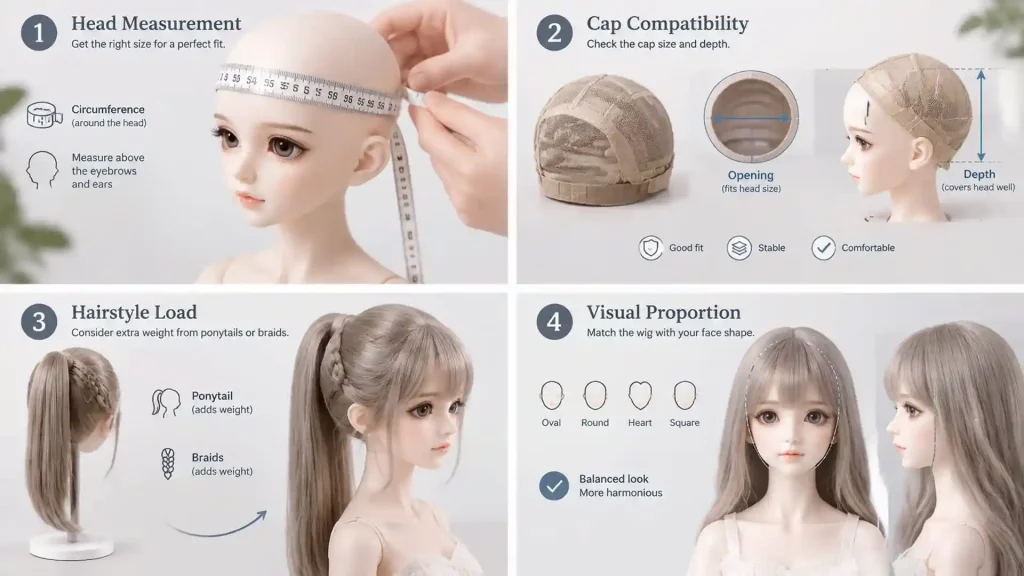
A practical wig decision can be organized into four layers.
1. Head Measurement
Check the doll’s head circumference using a consistent method. Record head shape, forehead height, crown shape, and any unusual contour that may affect the cap.
2. Cap Compatibility
Check the cap opening, cap depth, cap shape, adjustment range, and the seller’s fit model. Circumference is only one part of how a cap sits on the head.
3. Hairstyle Load
Consider the weight and volume of the hairstyle you intend to use. Long, dense, or heavily styled hair can pull a cap backward or cause it to rotate. A wig that is stable with the hair down may behave differently in a high ponytail or braid.
4. Visual Proportion
Consider hairline position, crown height, side volume, bangs, length, and overall balance with the sculpt. The same wig can create different impressions on a childlike, mature, narrow, broad, or unusually shaped head.
Wig fit is the interaction between the head, the cap, the hairstyle, and the final visual proportion.
Physical Fit and Visual Fit Are Different
Physical fit concerns whether the wig can be placed without force, stays reasonably stable, and does not create excessive pressure. It also includes whether the intended hairstyle can be used without the cap constantly shifting.
Visual fit concerns proportion, face framing, hairline, volume, character impression, and overall balance. A wig may stay securely on the head while still appearing too bulky, too deep, too flat, or unsuitable for the sculpt.
| Fit Type | Main Question | Examples of Failure |
|---|---|---|
| Physical fit | Can the wig sit securely and be used without excessive pressure? | Sliding, rotating, gaps, restrictive opening, or unstable styling |
| Visual fit | Does the hair look proportionate and suit the intended character? | Bulky silhouette, low hairline, excessive crown height, or unsuitable face balance |
Visual fit is subjective, but it is not random. The sculpt’s face shape, forehead height, head size, hair density, hairline, and intended character style all influence the result.
Anime, Natural, and Character Styling Considerations
Wig style changes the visual impression of a BJD. A large, rounded, highly voluminous style may create a more stylized or youthful effect. A flatter or closer-fitting style may create a more natural or mature impression. These are tendencies, not fixed rules.
Consider the following factors together:
- crown height;
- side volume;
- bang length and direction;
- hairline position;
- fiber shine and texture;
- hair length;
- face sculpt and forehead height;
- the desired character or fashion concept.
A style that looks balanced on one head may overwhelm another. Product photos are useful for understanding the intended silhouette, but they do not prove that the same wig will create the same result on every sculpt.
Common BJD Wig Fit Problems
| Problem | Possible Cause | What to Check Next |
|---|---|---|
| Wig slides backward | Cap is loose, shallow, poorly shaped, or pulled by heavy hair | Head measurement, cap depth, cap shape, hair weight, and adjustment range |
| Wig rotates | Opening is loose or the hairstyle is weighted unevenly | Side stability, cap shape, adjustment, and hairstyle balance |
| Wig is too tight | Head is outside the recommended range or opening is restrictive | Stop forcing it; verify measurement path, opening, and seller’s range |
| Hairline sits too low | Cap is too deep or positioned too far forward | Cap depth, forehead height, crown position, and hairline design |
| Part of the head is exposed | Cap is too shallow or the head is deeper than the fit model | Crown, sides, back coverage, and cap depth |
| Gaps appear at the sides or back | Head shape and cap shape do not follow each other closely | Head contour, cap shape, opening, and whether adjustment can close the gap |
| Wig looks too bulky | Hair density, side volume, crown height, or thickness is large relative to the sculpt | Unstyled silhouette, side volume, hairline, and face proportions |
| Wig fits with hair down but not after styling | Ponytails, braids, or heavy sections change weight distribution | Stability before and after styling, adjustment, and hairstyle load |
| Bangs sit incorrectly | Cap depth, forehead height, fiber direction, or pre-styling differs | Hairline position, fit photos, and whether bangs are fixed or restylable |
Real-World Fit Scenarios
The Circumference Matches, but the Wig Slides Back
A doll with a flatter back-of-head contour may not hold a rounded cap securely, even when the circumference is within the seller’s range. The problem may be cap shape or depth rather than the circumference itself. Check the fit model and ask whether the cap has an adjustment system.
The Wig Is Stable with Hair Down but Rotates in a Ponytail
A long or dense ponytail moves the center of gravity away from the middle of the head. This can pull a borderline-fitting wig backward or make it rotate. Consider hairstyle weight, attachment points, adjustment range, and whether the wig was designed for updos.
A Short Wig Fits but the Hairline Sits Too Low
A short style makes cap depth and hairline position easy to see. The circumference may be suitable while the cap extends too far down the forehead. This is primarily a cap-depth or visual-fit problem, not necessarily a circumference problem.
Cross-Brand and Secondhand Wig Checks
Cross-brand compatibility is possible when the head measurement, head shape, cap construction, adjustment range, and hairstyle are compatible. A shared scale label or similar doll height does not establish compatibility by itself.
When buying secondhand, ask for the current condition and measurements. Confirm whether the wig has been:
- cut;
- glued;
- stretched;
- restyled;
- washed;
- stored under tension;
- exposed to heat or humidity.
Ask whether the photos show the exact item being sold or only a sample. Save the listing, measurements, photographs, seller answers, and return or exchange terms.When comparing a blank doll with a fullset, also confirm whether the listed wig is included, whether it is the exact wig shown in the photos, and whether the seller provides its size or fit information. Our guide to Blank vs Fullset BJD explains why included accessories should be checked rather than assumed.
What to Check Before Trying on a New Wig
Before opening, modifying, cutting, gluing, dyeing, or permanently restyling a new wig, read the seller’s return and exchange policy. A seller may restrict returns after the package is opened or the item is altered, so do not assume that an ill-fitting wig can automatically be returned.
- Keep packaging, labels, and tags whenever possible.
- Inspect the cap, elastic, hairline, and fibers before making changes.
- Try the wig on a clean, dry head without unnecessary force.
- Take photographs before cutting or restyling.
- Do not force a wig that is clearly too tight.
- Record how the wig fits before and after styling.
- Follow the maker’s guidance for resin protection and wig storage.
Wig fit is only one part of a first BJD purchase. Before paying, review the wider First BJD Buying Checklist, including what is included, production or processing time, shipping, payment protection, seller communication, and return conditions.
Color-Transfer Considerations
Some dyed wig fibers or caps may transfer color to light-colored resin, but the risk depends on the fiber, dye, cap material, contact time, humidity, heat, surface finish, and storage conditions. Do not assume that every dark wig will transfer color, and do not assume that a protective layer eliminates every risk.
Follow the wig maker’s care guidance and use an appropriate protective barrier when suitable. If you are uncertain, avoid prolonged contact until the material and care requirements have been checked.
Questions to Ask a Wig Seller
- What doll head circumference range is recommended for this specific wig?
- What measurement path and units were used?
- Does the listed number refer to recommended head size, cap circumference, or cap opening?
- What is the cap depth, and how is it measured?
- What adjustment system does the wig use?
- How much adjustment is available?
- Which doll head or sculpt is shown in the photos?
- What is the measured head circumference of the fit model?
- Is the photographed wig the actual item or only a sample?
- How dense or heavy is the hair compared with the photos?
- Are the bangs fixed, pre-styled, or intended to be restyled?
- Was the wig designed for ponytails, braids, or other updos?
- What inspection, return, or exchange terms apply?
- Are there any care or color-transfer precautions?
Common BJD Wig-Buying Mistakes
- Choosing by doll height. Height describes the body, not the exact head circumference or cap shape. Measure the head instead.
- Choosing by MSD, SD, or 1/4 alone. Treat the label as a search category and verify the specific head and wig measurements.
- Assuming cap size and recommended head size are identical. Ask what the number represents before comparing it with your measurement.
- Assuming every seller measures the same way. Follow the seller’s diagram or stated method whenever one is available.
- Measuring over a thick wig cap or accessories. Measure the bare head unless the product is specifically intended to be worn over that layer.
- Ignoring cap depth. A suitable circumference does not guarantee a suitable hairline or head coverage.
- Ignoring hairstyle volume. Long, dense, or elevated styles can change the wig’s stability and visual proportion.
- Assuming all wigs with the same label fit alike. Compare cap opening, depth, shape, elasticity, density, and construction for each product.
- Treating a fit photo as universal proof. Identify the photographed head and compare it with your own doll.
- Confusing physical fit with visual fit. A secure wig may still be too bulky, too deep, or unsuitable for the intended character.
- Assuming adjustment hardware fixes every mismatch. Adjustment can accommodate limited variation, but it cannot correct every problem in shape, depth, or opening.
- Trying on the wig after modifying it. Check the return policy and inspect the fit before cutting, gluing, dyeing, or permanently restyling.
- Ignoring the difference between a sample and the actual item. Ask whether the product photographs show the exact wig being sold.
- Failing to check secondhand condition. Stretching, heat, restyling, or storage under tension may change the fit and appearance.
BJD Wig Measurement Worksheet
Use this worksheet to record the information behind each purchase. Keeping the measurement method makes future comparisons more reliable, especially when buying from the same seller or maker again.
DOLL HEAD RECORD

Maker:
Sculpt:
Body or head model:
Measurement date:
Measurement unit:
Head measurement path:
Head circumference:
Head shape notes:
Forehead or crown notes:
Planned wig style:
Planned layers or wig cap:

WIG RECORD

Seller or maker:
Product name:
Product URL:
Advertised size:
Recommended head range:
What the listed number measures:
Cap circumference:
Cap opening:
Cap depth:
Adjustment system:
Adjustment range:
Hair density:
Hair volume notes:
Fit model:
Sample or actual item:
Condition:
Care or color-transfer notes:
Questions sent:
Seller's reply:
Return or exchange terms:

FIT CHECK

Fit before styling:
Fit after styling:
Slides:
Rotates:
Gaps:
Pressure:
Hairline position:
Visual proportion:
Decision:
Decision confidence: High / Medium / Low
Final BJD Wig Purchase Checklist
- Identify the exact doll head or sculpt.
- Measure the head using a consistent method.
- Record the measurement path, unit, and date.
- Use MSD, SD, YoSD, 1/4, and 1/3 labels only to shortlist candidates.
- Confirm what the seller’s listed number actually measures.
- Compare your measurement with the seller’s recommended head range.
- Check cap depth, cap opening, cap shape, and adjustment range.
- Consider forehead, crown, and back-of-head shape.
- Consider hair density, weight, volume, bangs, ponytails, and braids.
- Separate physical fit from visual proportion.
- Ask for missing measurements and fit-model information.
- Check the inspection, return, and exchange policy before modifying the wig.
- Save the listing, photographs, measurements, and seller replies.
Frequently Asked Questions
How do I choose a BJD wig size?
Measure your doll’s head using the seller’s stated measurement path whenever one is provided. Use labels such as MSD, SD, or YoSD to find possible candidates, then compare the actual head measurement with the seller’s recommended range, cap depth, opening, adjustment system, and fit model.
Are BJD wig sizes universal?
No. BJD wig labels and inch ranges are not universal standards. Depending on the seller, a number may describe a recommended head range, cap circumference, cap opening, or another measurement. Always check the listing’s definition and method before comparing it with your doll’s head.
Does an MSD wig fit every MSD doll?
No. MSD is a broad category rather than a guaranteed compatibility standard. Dolls in this category can differ in circumference, head depth, forehead shape, and overall contour. Compare your doll’s measurements with the specific wig’s information instead of relying on the MSD label alone.
Does a 7–8 inch label mean the same thing for every seller?
No. One seller may use an inch range for recommended head circumference, while another may describe a cap measurement or an internal product category. Ask what the number measures and whether the seller provides a measurement path or fit-model information.
Should I measure the doll’s head or the wig?
Start by measuring the doll’s head. Then identify which wig measurements the seller provides, such as recommended head range, cap circumference, opening, or depth. These measurements are not automatically interchangeable, so compare only figures that use compatible definitions and methods.
Why is my BJD wig too loose?
Possible causes include a large opening, insufficient adjustment range, a mismatched cap shape, a shallow cap, or hairstyle weight pulling the wig out of position. Recheck the head measurement, cap depth, opening, head contour, and hairstyle load before deciding whether the size label was the problem.
Why is my BJD wig too tight?
Your doll may be outside the seller’s recommended range, the opening may be restrictive, or the cap shape may create pressure at a particular point. Do not force the wig into place. Recheck the measurement method and ask the seller about cap opening, depth, and adjustment.
Can a BJD wig fit physically but still look wrong?
Yes. Physical fit concerns security and pressure, while visual fit concerns hairline, volume, face balance, and character impression. A wig may stay on securely but appear too bulky, too deep, too flat, or poorly proportioned for a particular sculpt.
Does hair volume affect BJD wig fit?
Yes. Dense or heavily styled hair adds weight and changes the center of gravity. Long hair, ponytails, and braids may pull a cap backward or cause rotation. Hair volume also changes the apparent size of the head and the overall balance of the face.
Can BJD wigs fit across brands?
They can, but compatibility depends on head measurement, head shape, cap construction, adjustment range, and hairstyle. A shared scale label or similar doll height is not enough to establish fit. Compare the specific head and wig information before ordering.
How do I choose a wig for a childlike or mature BJD?
Consider both physical fit and visual proportion. A high-volume style may create a more stylized or youthful impression, while a closer-fitting style may appear more natural or mature, but these effects depend on the sculpt, forehead, hairline, density, and intended character design.
What should I ask a wig seller before ordering?
Ask for the recommended head range, measurement method, cap opening, cap depth, adjustment system, fit-model information, hair density, and return or exchange terms. If you plan to use bangs, ponytails, braids, or a wig cap, mention that intended use when asking about fit.
Conclusion
The safest way to choose a BJD wig is to combine a consistent head measurement with seller-specific information about the cap and hairstyle. Head circumference is the starting point, not a complete fit test.
Use size labels to find candidates, but verify what the seller’s numbers mean. Check cap depth, opening, shape, adjustment range, hair density, hairstyle weight, and visual proportion. A wig that is physically compatible may still create the wrong hairline or silhouette, while a nearby size may sometimes work when its construction is suitable and the seller confirms it.
The most reliable principle is simple:
Measure the head, understand the cap, consider the hairstyle, and judge the final proportion.
When important information is missing, asking the seller a precise question is safer than guessing from a broad label. This process cannot guarantee a perfect result in every case, but it substantially reduces avoidable fit mistakes and creates a clearer record for future BJD wig purchases.